
I grew up with the image of Simón Bolívar on his white horse, sword in hand. Long before I collected coins, I admired the courage of the man we called El Libertador. I used to wonder how someone with a vision and a small band of soldiers could rally enough people to challenge an empire. As I got older, I became just as curious about the people who joined him and how their efforts helped bring independence to so many places.
My own toned 1827 Potosí 8 soles brought that childhood curiosity back. I recognized the face right away. Then I noticed the date and thought about what it meant. Potosí put that portrait on silver while Bolívar was still alive. I’d grown up seeing his image everywhere, and here was one I could hold in my hand that came from his own lifetime.
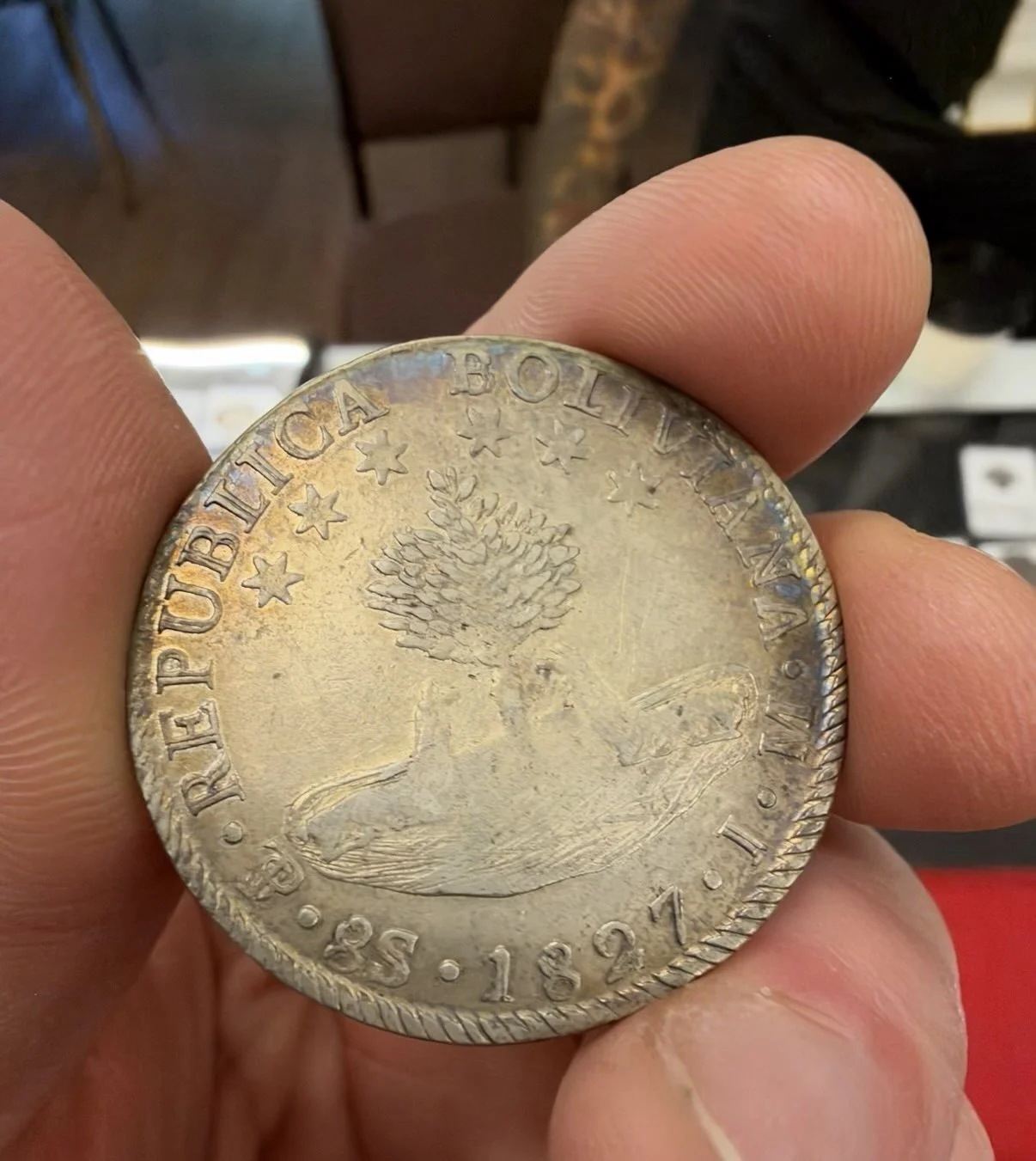
1827 Potosí 8 soles, JM. Reverse of the author’s personal specimen, showing the first-year republican design and golden and blue peripheral toning. Photograph: Collectorly.
The Grundy Collection’s 1827 8 soles, shown below, is a separate example of that first-year issue. Its 1835 8 soles carries the familiar portrait and raises a different question. Was Bolívar still alive when Potosí struck that later coin?
He had died in Santa Marta, Colombia, on December 17, 1830. By the time this coin was struck in Potosí, his portrait had already appeared on Bolivian silver for years. To find the design on a coin from his lifetime, go back to 1827, the first year Potosí struck silver for the new republic.
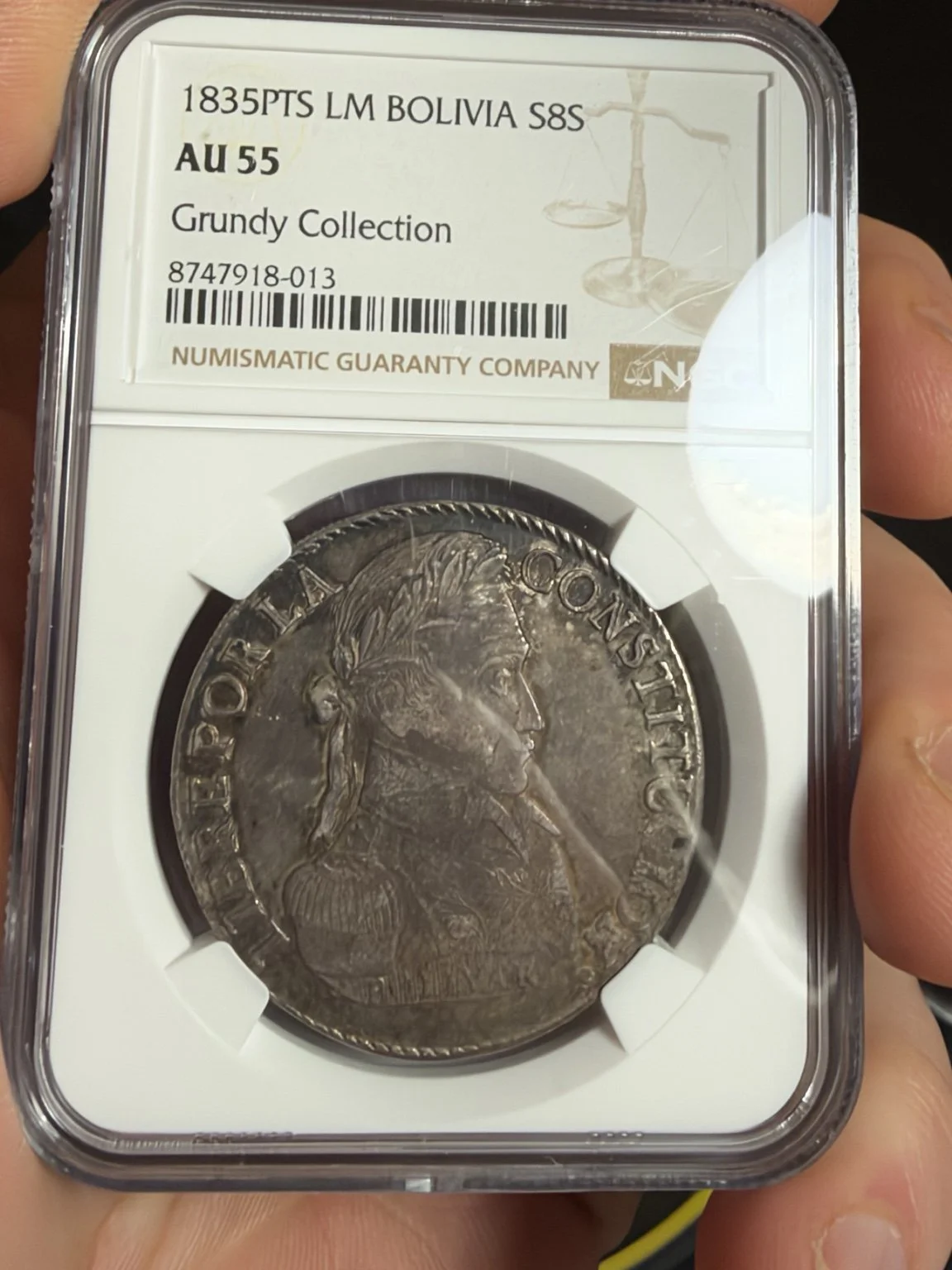
1835 Potosí 8 soles, assayers LM, NGC AU55. Ex Grundy Collection, Heritage Auctions, September 2026, lot 24101.
Who was Simón Bolívar?
Bolívar was born in Caracas in 1783 into a wealthy family whose holdings included estates, mines, and enslaved people. He became a leader in the wars that broke Spain’s rule across much of northern South America. He survived the collapse of the early Venezuelan republics and rebuilt his military campaign with help from Haitian president Alexandre Pétion, who supplied support in 1816 in exchange for a commitment to emancipation.
In 1819, Bolívar led his army across the Andes into New Granada and defeated royalist forces at Boyacá. That victory opened the way to Bogotá and helped make possible the Republic of Colombia, now commonly called Gran Colombia. Bolívar wanted the new republics to stand together against foreign intervention. He also put considerable faith in centralized authority. Article 77 of Bolivia’s 1826 constitution, which he helped shape, placed the executive in the hands of a president for life, a vice president, and three ministers. By the time he died at 47, Gran Colombia was breaking apart.
Bolivia’s independence also owed much to Antonio José de Sucre. He commanded the patriot army at Ayacucho in December 1824, a decisive defeat for Spanish power in Peru. On August 6, 1825, delegates in Chuquisaca declared Upper Peru independent. The new country took Bolívar’s name, and Sucre became its next president.
Medals from Bolívar’s lifetime
Bolívar arrived in Potosí on October 5, 1825, and reached Chuquisaca in early November. The medals made for those celebrations show how each city wanted the visit to be remembered. The dates on these pieces precede Bolivia’s first regular republican silver coinage by two years.
Potosí’s tribute, 1825
On the large silver Potosí medal, Bolívar appears in uniform as the liberator of Colombia and Peru. Turn it over and the focus shifts to the city itself, with a radiant sun over Cerro Rico and buildings at the foot of the mountain. The inscription thanks Bolívar as the genio de la libertad. A separate Potosí medal documented by the Banco Central de Bolivia shows the town and mountain on one side and a llama between branches on the other. Its legend records the gratitude of Potosí’s employees and salutes the liberators of Colombia and Peru.
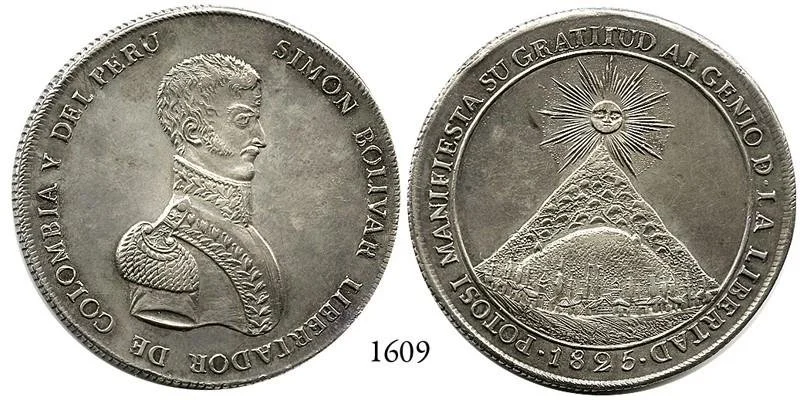
1825 Potosí proclamation medal, silver. Bolívar’s military bust faces right on the obverse. The reverse puts Cerro Rico above the city. Photograph from the auction archive on iCollector.
The Chuquisaca proclamation medal, 1825
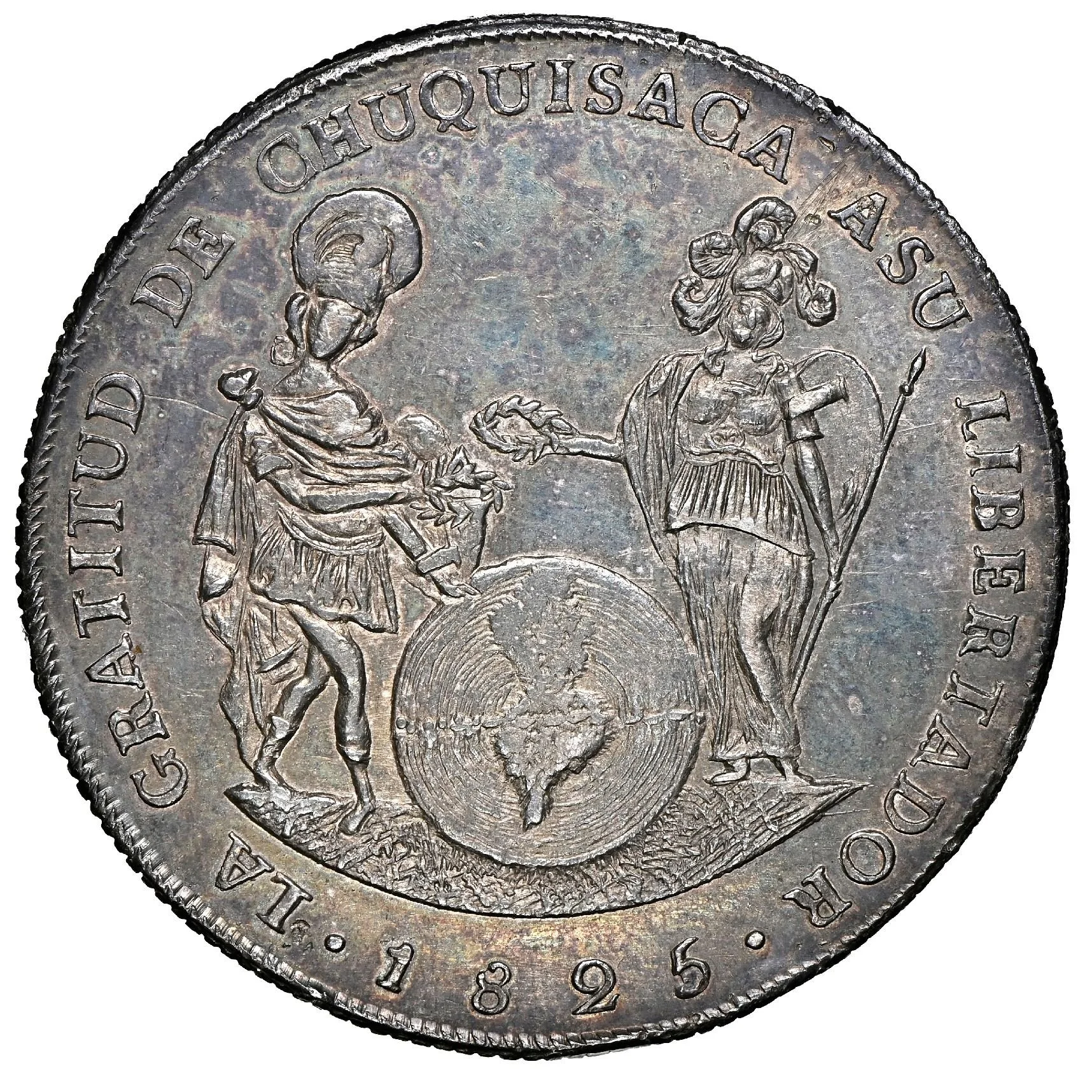
Chuquisaca’s silver proclamation medal calls Bolívar Padre de la Patria, or Father of the Country. The reverse places two allegorical figures beside a globe showing the Americas. The legend names the city and thanks its liberator. Where Potosí chose its mountain, Chuquisaca used the globe to place a local celebration in a wider American story.
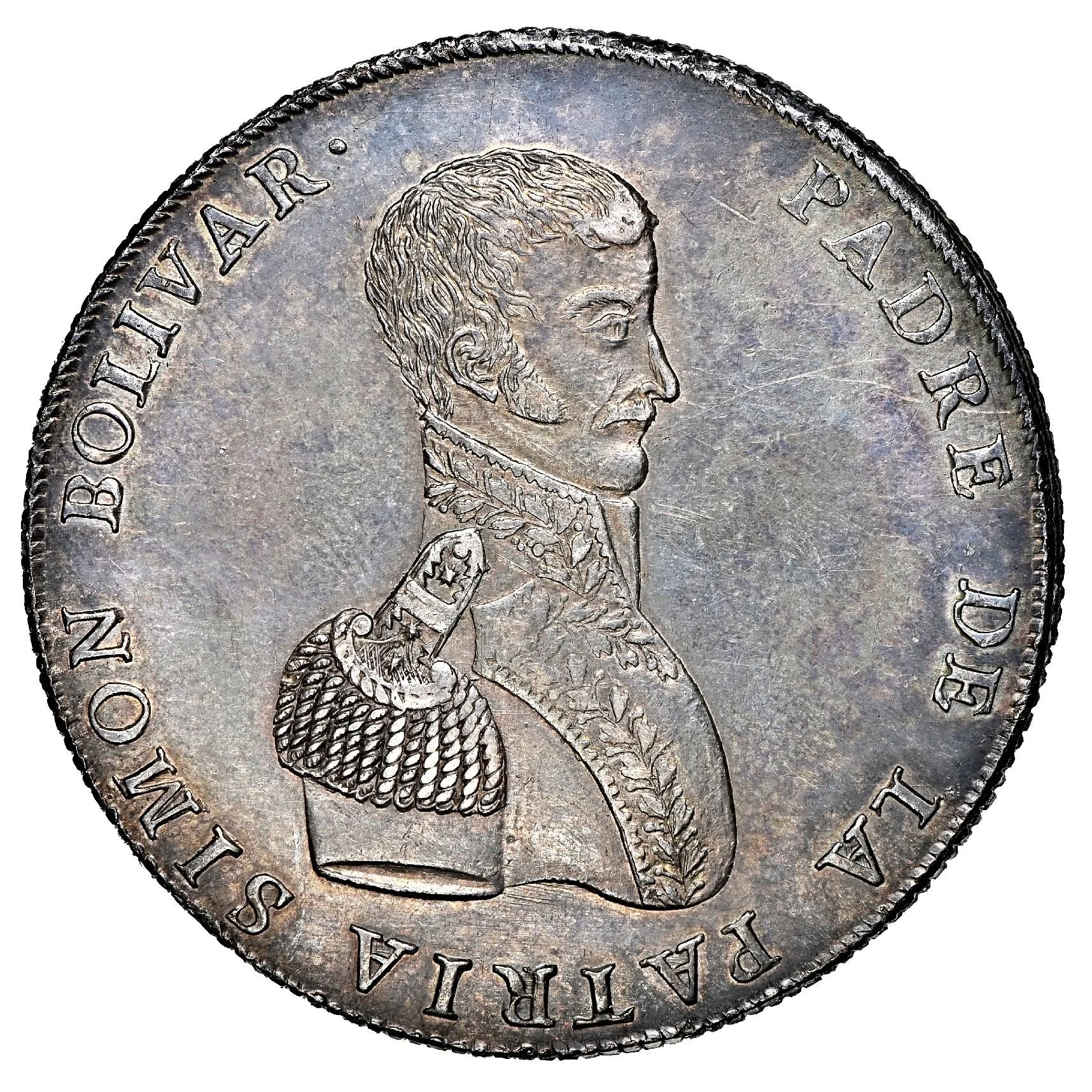
1825 Chuquisaca proclamation medal, silver. Left, Bolívar as Father of the Country. Right, two figures beside a globe. NGC MS61 specimen, photographs from the auction archive on iCollector.
The assembly’s gold medal, commissioned in 1825
The new republic also commissioned a gold medal set with diamonds as a personal honor for Bolívar. The medal was made at the Potosí mint and sent to him in Lima in June 1826, accompanied by a letter from Sucre. Bolívar returned it to the nation in his will. An 1839 law made the medal one of Bolivia’s presidential insignia, giving an award made during his lifetime a place in the republic’s later history.
The Banco Central de Bolivia documents a detail worth knowing when identifying examples. Period impressions in gold and silver were made from the same dies as the original award. The original jewel also changed over time. The bank’s catalog reproduces photographs of the center medallion and the complete insignia as they appeared when documented.
Bogotá marks Bolívar’s survival, 1829
Bolívar’s contemporaries also used medals to record a crisis in his own political life. On September 25, 1828, conspirators attacked the presidential palace in Bogotá. His supporters commissioned a silver medal struck there in October 1829. On the obverse, his bust sits on a pedestal like a public monument. The reverse credits divine providence with saving him and names the night of the attack. The language is personal and religious, a striking departure from the civic gratitude on the Bolivian medals of 1825.
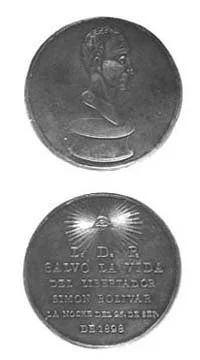
1829 Bogotá medal commemorating Bolívar’s survival. Former Alfredo Boulton Collection. Archival photograph from the Colección Bolivariana exhibition catalog, plate III/9.
From Ferdinand VII to Bolívar
When I traveled to Bolivia with my father in 2025, one of the coins I spent time with was an 1825 Potosí 8 reales. It still carries the portrait of Ferdinand VII. The date is what makes it so interesting to me. Bolivia declared independence on August 6 of that same year, and 1825 marks the final date of Potosí’s colonial 8 reales.
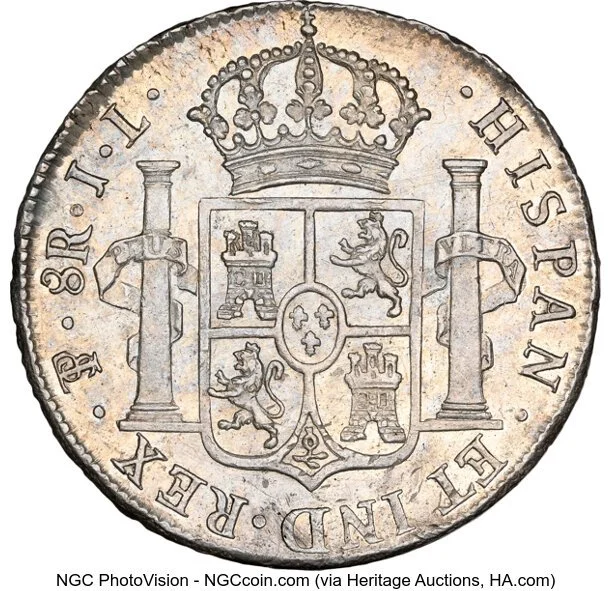
The monetary law of November 20, 1826, called for Bolívar’s bust and the constitutional motto on the republic’s silver. In 1827, the first regular republican silver left the same mint with a different portrait and a new denomination. The 8 soles shows Bolívar in military dress, with LIBRE POR LA CONSTITUCIÓN around him. The reverse names the REPÚBLICA BOLIVIANA and shows two llamas beneath a tree, with six stars representing the republic’s original departments. The Banco Central de Bolivia also records an edge inscription on the early 8 soles that reads AYACUCHO SUCRE 1824. Bolívar has the portrait, and Sucre’s victory is written on the edge.
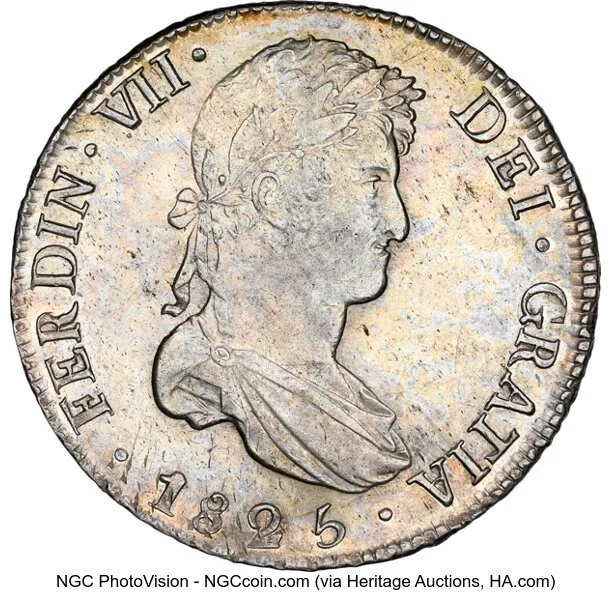
1825 PTS–JL 8 reales, NGC MS60. Ferdinand VII and the crowned Spanish shield. Grundy Collection, Heritage lot 24086. NGC PhotoVision via Heritage Auctions.
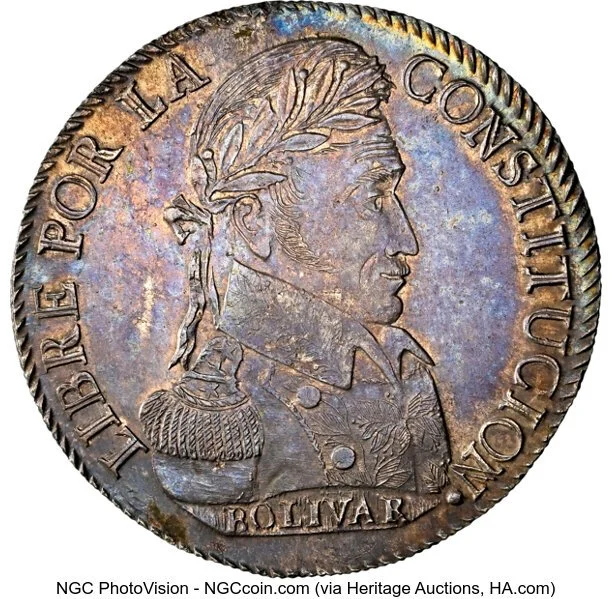
1827 PTS–JM 8 soles, NGC MS61. Bolívar and the republic’s new emblems. Grundy Collection, Heritage lot 24088. NGC PhotoVision via Heritage Auctions.
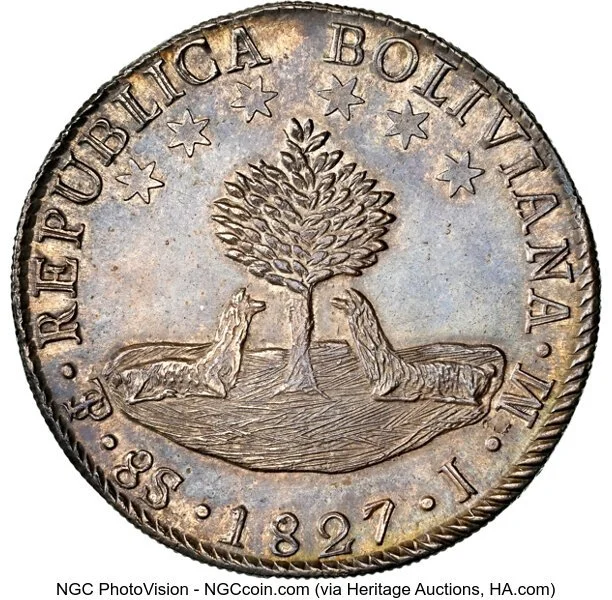
Start with the reverse. The 1825 coin puts a crown above the Spanish arms and pillars beside them. The 1827 coin gives the center to a tree and two animals, with REPÚBLICA BOLIVIANA around the rim. The mint’s monogram still identifies Potosí. The letters JL and JM are assayer initials, so the mint and the people responsible for assaying the silver can still be read on each piece.
Both coins are large silver pieces of roughly 27 grams, according to Heritage’s catalog specifications. The names changed from reales to soles, and the familiar size stayed close. That continuity makes the change of symbols all the more visible.
The Grundy Collection
The name on the holder traces this 1835 coin to a collection that began with U.S. coins in 1962. By the 1980s, the collector had turned his attention to machine-struck silver crowns from Europe and Latin America. Heritage sold the European portion in 2009 and offered the Latin American material in September 2026. The collector wanted his crowns to return to the market after his death so future generations could collect and study them.
The Potosí sequence in the September showcase gives a sense of how he collected. It included late colonial 8 reales of Ferdinand VII, a first-year 1827 PTS–JM 8 soles graded NGC MS61, and republican issues dated 1828, 1829, and 1830. The 1835 coin pictured here sat a few lots farther along in that same run. Seeing those pieces together makes it possible to follow the design across successive dates and assayers.
The 1827 specimen photographed here is particularly clear at the eyebrow, mustache, and uniform. Heritage described it as unusually well struck for the series. That makes it a useful reference when comparing portraits on later dates, where the same details can look softer.
Finding a coin from Bolívar’s lifetime
The first-year 1827 PTS–JM 8 soles is the one I’d choose to tell this story. The 1828 and 1829 PTS–JM issues also date to his lifetime. The 1830 coins are especially interesting because they carry the year he died. With his death coming so late in December, the date alone leaves the precise timing of any individual strike open.
The portrait appeared on smaller silver denominations too, including the half sol, 1 sol, 2 soles and 4 soles.
What stays with me about the 1835 is how easily it feels contemporary with the man. Potosí was still striking silver with his portrait years after his death. Set it beside a Ferdinand VII 8 reales dated 1825, a medal from Bolívar’s visit that year, and an 1827 8 soles. The royal coin, the civic tribute, and the new republic’s currency each show what Potosí was asked to put on silver as power changed hands.
Gold coins from Bolívar’s lifetime
The gold tells a slightly different story from the silver. Potosí struck gold while Bolívar was alive under Ferdinand VII. The Banco Central de Bolivia dates the mint’s first gold issues for the Bolivian republic to 1831, under Andrés de Santa Cruz, after Bolívar’s death on December 17, 1830. The assembly’s gold medal belongs to his lifetime as a presentation award. For gold coins from a republic tied to his career, the mints of Popayán and Lima offer two examples.
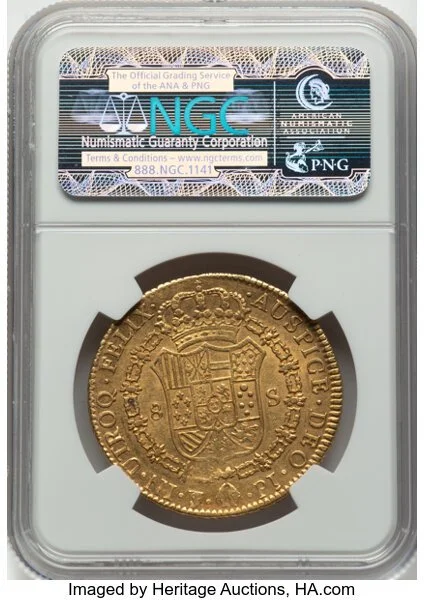
Potosí, 1824. Ferdinand VII’s last colonial 8 escudos
The 1824 PTS–PJ gold 8 escudos is the last dated colonial 8 escudos issue of Potosí. It was struck in what is now Bolivia while Bolívar was alive, and it carries a laureate bust of Ferdinand VII and the crowned arms of Spain. Paired with the 1825 silver 8 reales shown above, it gives you two denominations from the same mint in the closing years of royal coinage.
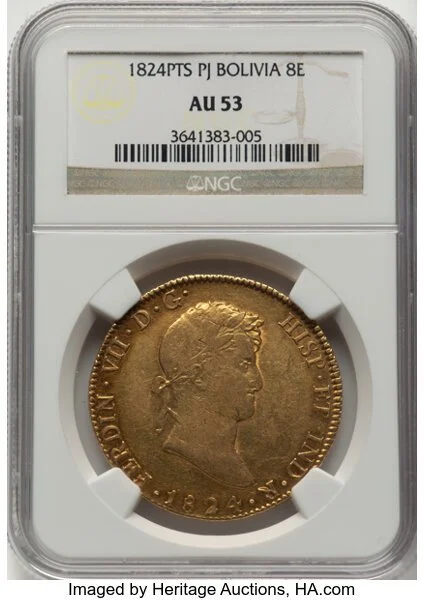
1824 PTS–PJ 8 escudos, NGC AU53. Ferdinand VII and the crowned Spanish arms. Heritage Auctions, August 2026, lot 23061.
Popayán, 1822. Gold of the Republic of Colombia
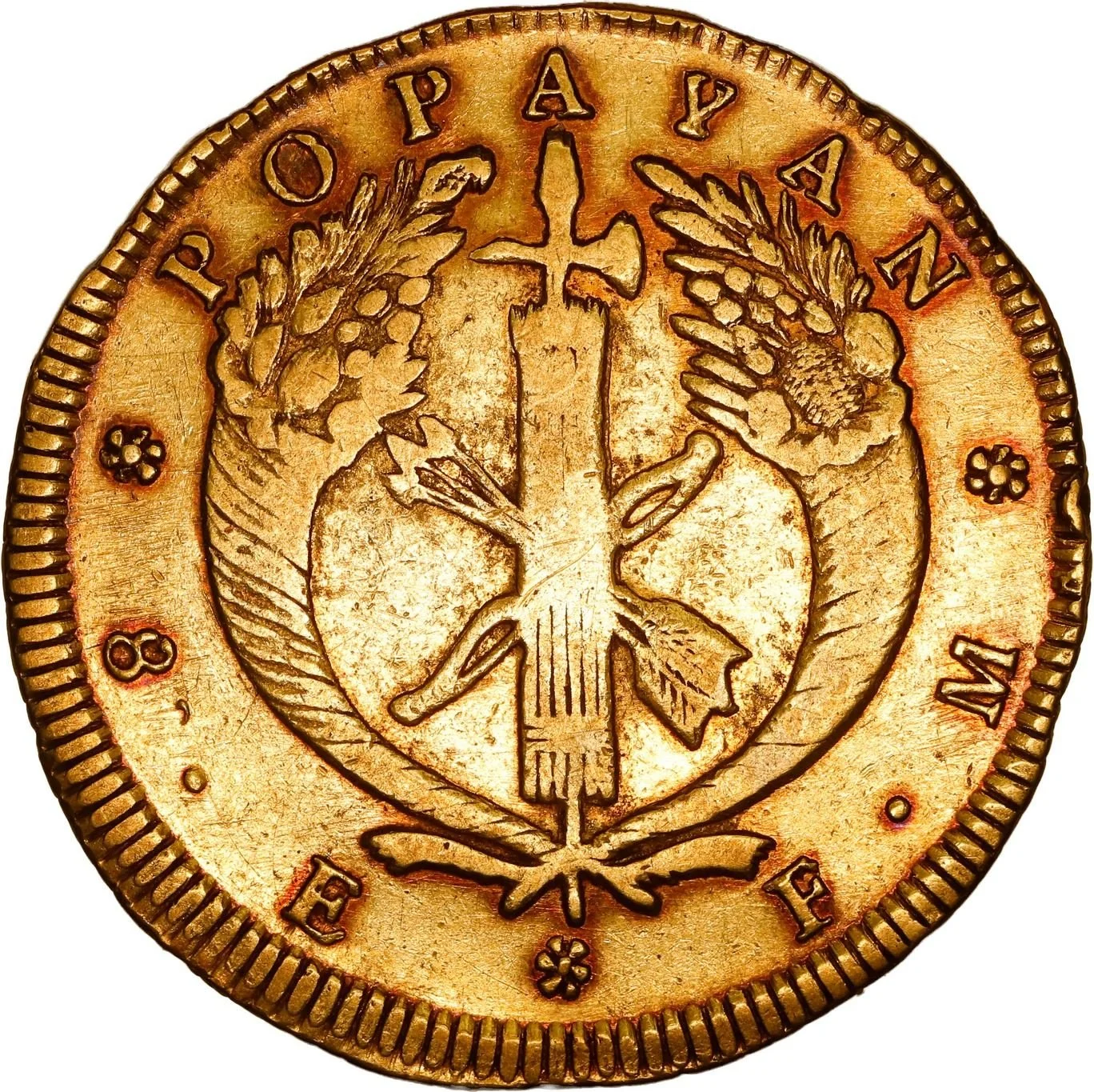
The 1822 FM gold 8 escudos comes from the first year of republican Colombian gold. Popayán was part of the Republic of Colombia now commonly called Gran Colombia, of which Bolívar was president. Its classical bust represents Liberty. The other face shows the republic’s arms, where the bundle of rods known as fasces appears between cornucopias. The denomination carries forward the familiar Spanish eight-escudo standard while the design names a new republic.
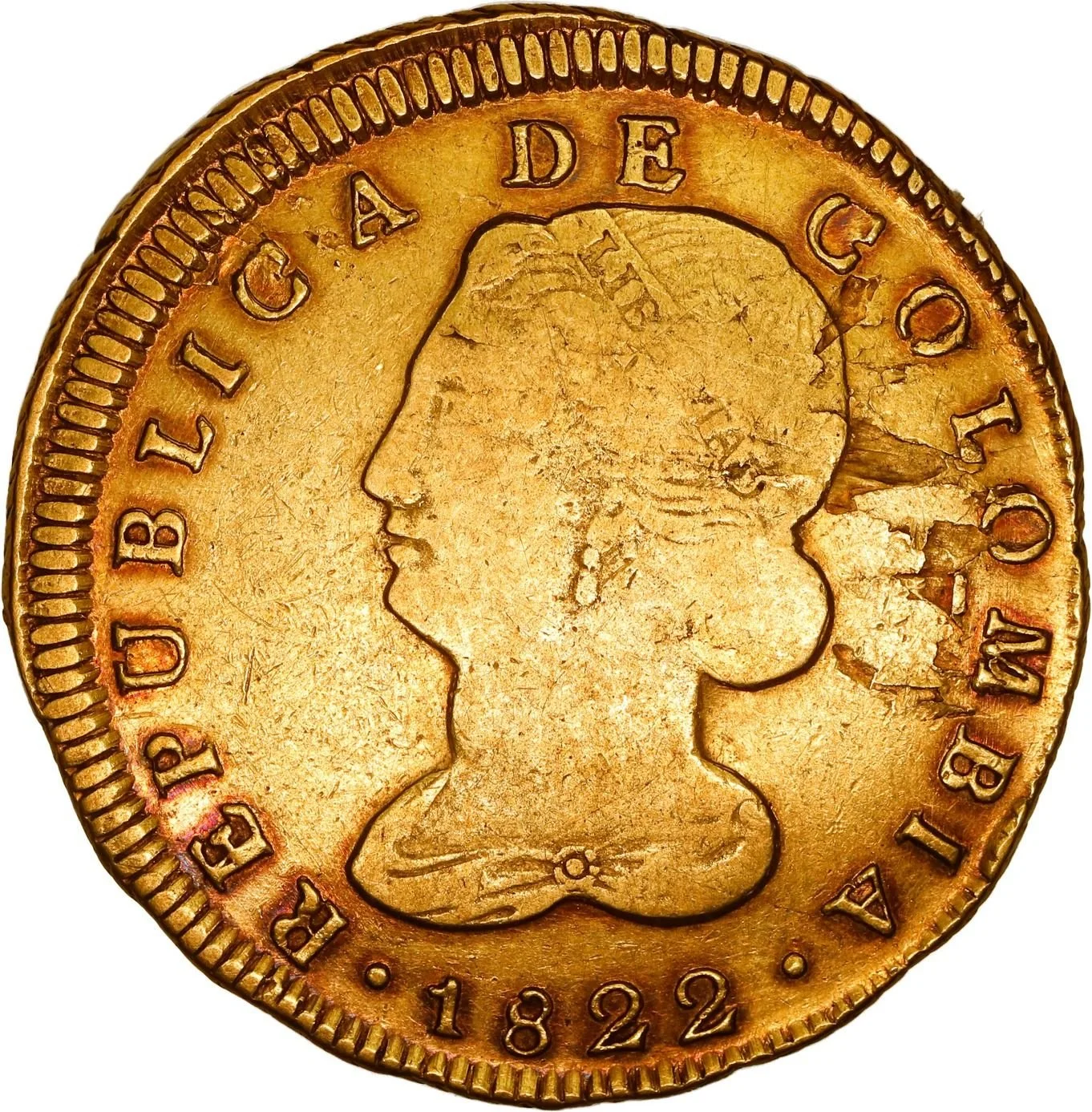
1822 FM 8 escudos, Popayán. Liberty and the arms of the Republic of Colombia. Ex JEAS Collection, photographs from Sedwick & Associates.
Lima, 1826. Standing Liberty in republican Peru
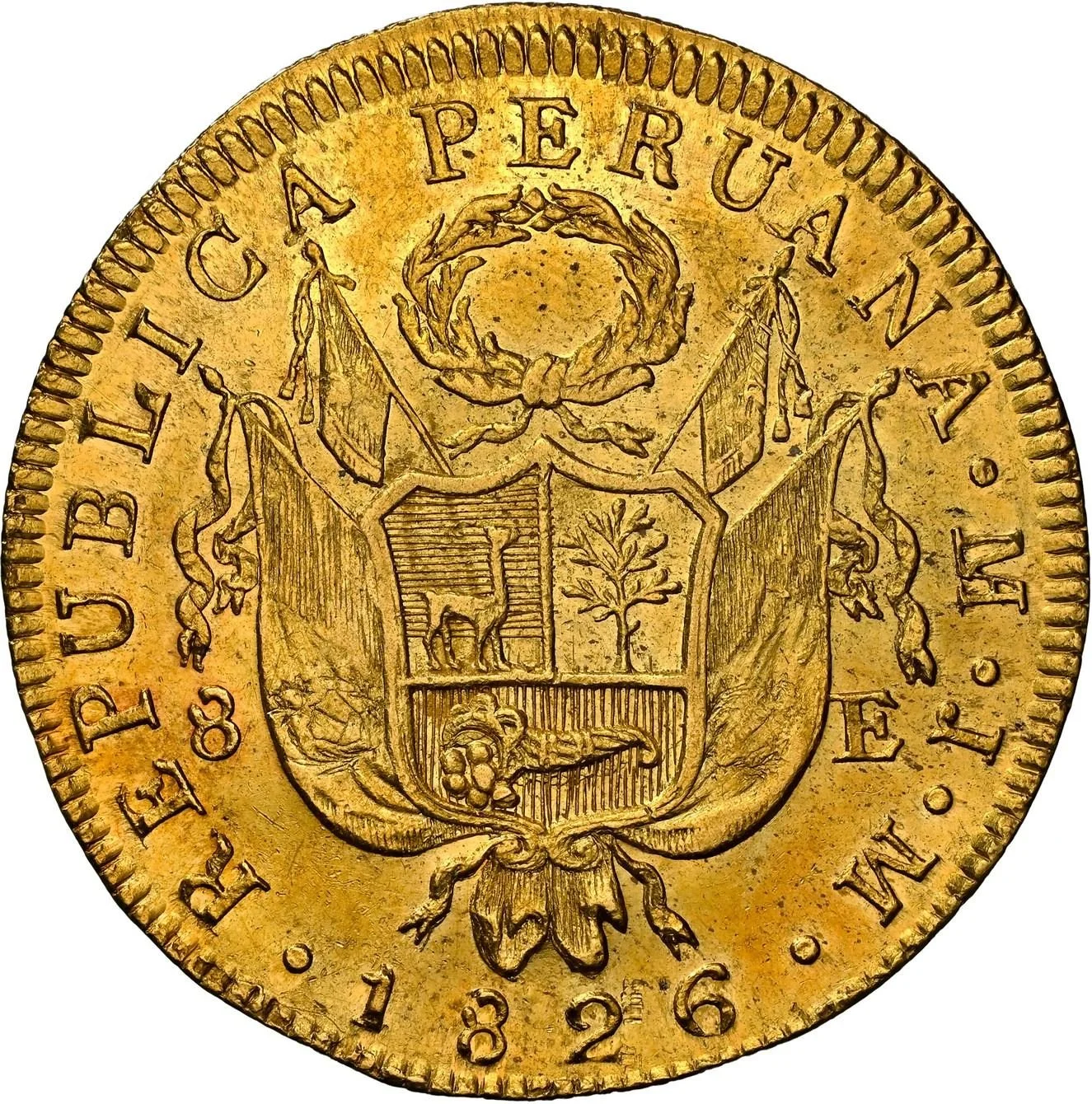
The 1826 Lima JM gold 8 escudos comes from the opening year of Peru’s regular republican gold coinage. One face shows a standing figure of Liberty with the motto FIRME Y FELIZ POR LA UNIÓN. The other names the Peruvian republic and carries its arms, with a vicuña, a cinchona tree, and a cornucopia. Cuzco also issued republican gold dated 1826, including an 8 escudos with the standing Liberty design.
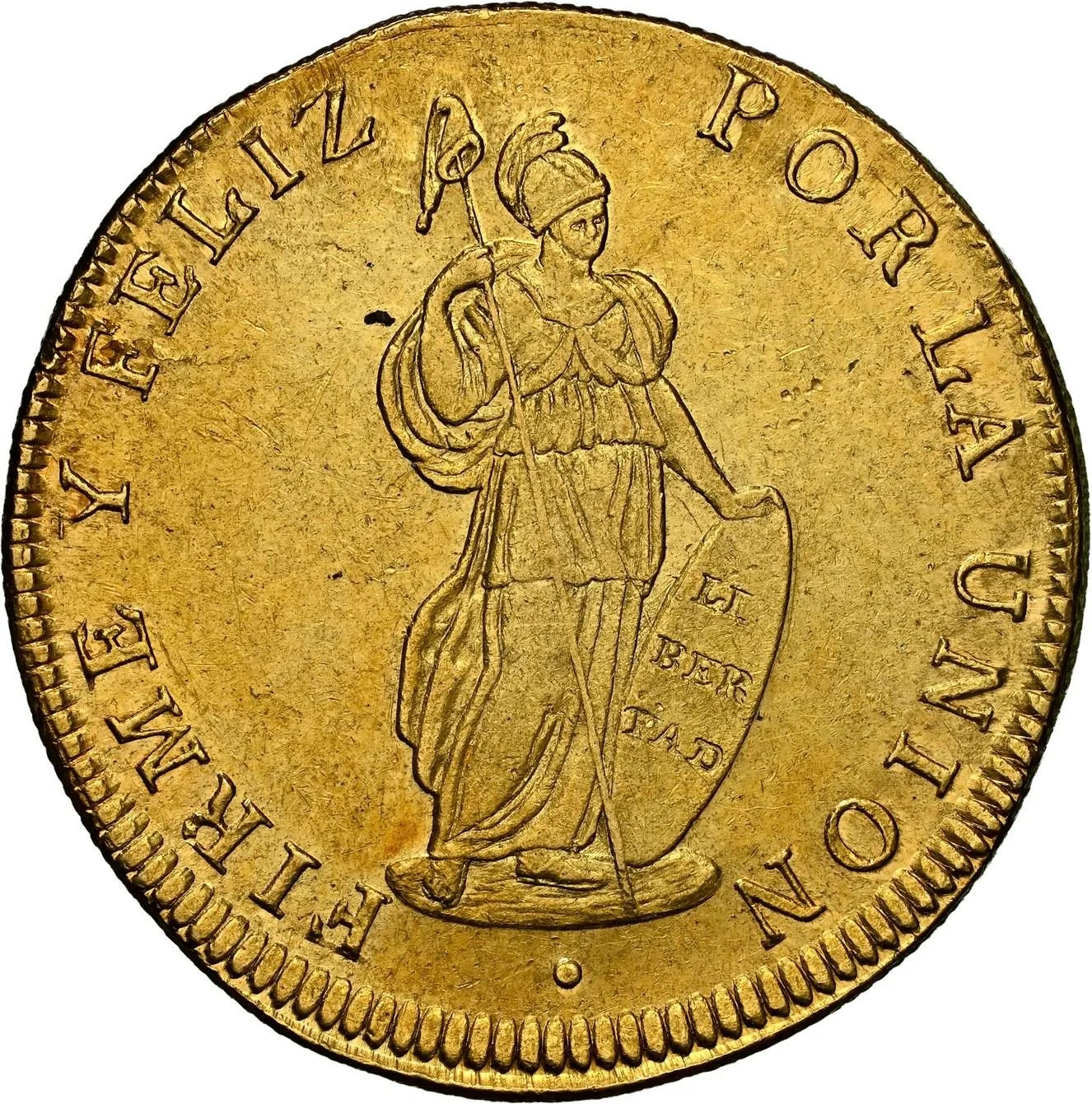
1826 Lima JM 8 escudos, NGC AU55. Standing Liberty and the Peruvian arms. Ex Almenara Collection, Sedwick & Associates, Treasure Auction 38, lot 1196.
Potosí, 1831. Bolívar’s portrait reaches republican gold
The 1831 PTS–JL gold 1 escudo brings the story back to Potosí. It belongs to the first year of Bolivian republican gold and carries the Liberator’s portrait after his death. A same-mint pairing captures the chronology well. The 1827 silver 8 soles carries a portrait issued during his lifetime, and the 1831 gold escudo shows how the republic continued to honor him.
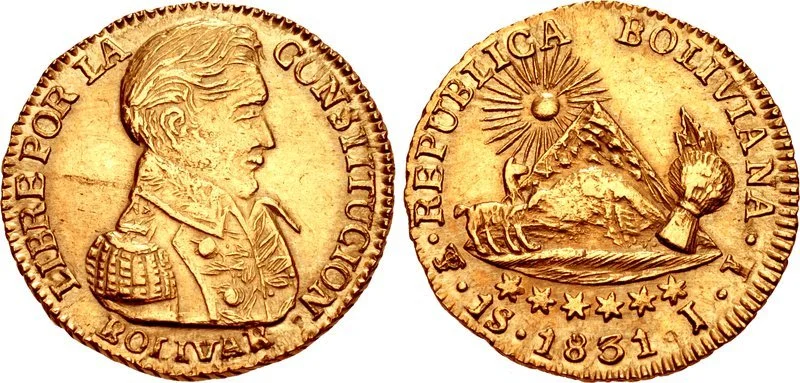
1831 PTS–JL 1 escudo, NGC MS62. First-year republican gold from Potosí, issued after Bolívar’s death. Lissner Collection, Classical Numismatic Group, lot 1208, photograph archived by CoinVarieties.
Sources and further reading
Banco de la República, Colombia, for Popayán and the republican gold standard — https://colecciones.banrepcultural.org/en/document/moneda-de-un-escudo-moneda-moneda/63a069145d96b8790f341cc3
CoinVarieties, catalog record for the 1831 Potosí escudo from the Lissner Collection — https://coinvarieties.com/index.php/Bolivia_1831-PTS_JL_scudo
Banco Central de Bolivia, virtual museum of coins and banknotes, for republican gold beginning in 1831 — https://www.bcb.gob.bo/?page=4&q=museo-virtual
Louis E. Eliasberg, Sr. Collection catalog, for late colonial Potosí gold — https://media.stacksbowers.com/VirtualCatalogs/CatalogLibrary/louiseeliasbergs2005amer.pdf
Stack's Bowers, Eldorado Collection catalog, for early Colombian gold and the 1822 Popayán issue — https://media.stacksbowers.com/VirtualCatalogs/CatalogLibrary/SBG_Eldorado_Coins_Catalog.pdf
Banco Central de Reserva del Perú, Historia de la moneda en el Perú, for Lima and Cuzco gold — https://www.bcrp.gob.pe/docs/Publicaciones/libros/2020/historia-de-la-moneda-en-el-peru.pdf
Joshua Simon, Simón Bolívar, Oxford Bibliographies in Atlantic History — https://academic.oup.com/reference/62333/reference-article-abstract/554086224
Tribunal Constitucional Plurinacional de Bolivia, Constitution of 1826, Article 77 — https://tcpbolivia.bo/tcp/sites/default/files/pdf/normas/cpe/Constitucion1826.pdf
Bolivia's monetary law of November 20, 1826, especially Article 2 — https://www.lexivox.org/norms/BO-L-18261120.xhtml
Biblioteca Virtual Miguel de Cervantes, Colección Bolivariana exhibition catalog, with photographs of the Potosí and Chuquisaca medals — https://www.cervantesvirtual.com/obra-visor/coleccion-bolivariana-ano-bicentenario-del-natalicio-del-libertador-simon-bolivar-17831983--0/html/ff5b12be-82b1-11df-acc7-002185ce6064_12.html
Ministry of Culture of Peru, independence exhibition catalog, with obverse and reverse images of the Chuquisaca medal — https://museos.cultura.pe/sites/default/files/publicaciones/pdf/CATALOGO%20INDEPENDENCIA%20comprimido.pdf
Medallas monetarias y conmemorativas de Bolivia, 1825–1925, including the assembly medal and the correspondence that accompanied it — https://ifinra.org/wp-content/uploads/2023/06/medallas-monetarias-y-conmemorativas-de-bolivia-1825-1925.pdf
Bolivian law of September 15, 1831, recording the medal's return under Bolívar's will — https://www.lexivox.org/norms/BO-L-18310915-2.xhtml
Bolivian law of October 28, 1839, designating the medal a presidential insignia — https://www.lexivox.org/norms/BO-L-18391028.xhtml
Heritage Auctions, The Grundy Collection showcase, September 2026 — https://coins.ha.com/c/auction-home.zx?saleNo=61650
Historia monetaria de Bolivia, volume 1, for the transition to the republican peso and soles — https://bibliotecadigital.bcb.gob.bo/xmlui/bitstream/handle/123456789/1735/Historia%20Monetaria%20de%20Bolivia%20T%201.pdf?sequence=1
Banco Central de Bolivia, first republican silver of 1827 — https://www.bcb.gob.bo/?q=node/219164
Banco Central de Bolivia, historical survey of Bolivian coinage — https://bibliotecadigital.bcb.gob.bo/xmlui/bitstream/handle/123456789/3244/Monedas%2C%20Monedas%20Conmemorativas%2C.pdf?sequence=1
Numista, Potosí 8 soles dates and assayer initials — https://es.numista.com/23224
Cambridge University Press, independence-era chronology — https://assets.cambridge.org/97805218/95675/frontmatter/9780521895675_frontmatter.pdf
