

Coin Adventures Kids — the book that started with a real coin
As a collector, I have spent years holding history in my hands. A silver real from Potosí. A piece of eight that crossed the ocean three hundred years ago. A coin with a face on it — a king, a sun — that somebody once carried in a pocket and spent on bread, or lost on a road, or buried in a hurry and never came back for.
Every time I hold one, I think the same thing: this coin has a story. And then I think: who is going to hear it?
That is why I wrote Coin Adventures Kids.
What I saw at the shows
I study coins. I go to shows. I walk the floor, table after table, case after case — and I see the same thing every time.
Everything is for adults. The coins, the books, the conversations — all for grown-ups who already collect. And the kids? The kids are standing next to their parents, bored. There is nothing for them. No book that speaks to them. No page they can touch. Nothing that says: this world is yours too.
And there is something else missing. Nobody is teaching kids about money. Not how a coin works, not what things cost, not how to save, not why some coins are worth more than others. Children grow up handling money every day, and nobody sits down to explain it to them — what it is, where it comes from, how to manage it.
That is the gap I saw. No content for kids in this world. And no content teaching kids how to manage money. So I decided to make it myself.
I drew this book
I am an artist and a graphic designer. That is who I am, before anything else. And I drew this book — every page, every character, every coin.
Niko, Maya, Grandpa Leo, Pirate R, Peso the macaw — they are mine. I designed them. The pirate ship on the moonlit waves, the treasure maps, the coins themselves — I drew them all, with an artist's eye and a designer's hand.
That matters, because a coloring book lives or dies by its art. If the drawing is flat, the child feels nothing. If the drawing is alive — if the ship looks like it could sail off the page, if the coin looks like you could pick it up — then the child leans in. They want to color it. They want to know what happens next.
I did not hire someone to illustrate my idea. I am the artist. The art is mine, and the story is mine, and they belong together.
Volume 1: The Americas
Coin Adventures Kids, Volume 1: The Americas, is an activity and coloring book for ages 6–12. It is not a textbook. It is an adventure.
The book follows Niko and Maya, two young explorers, with their Grandpa Leo, Pirate R, and Peso the macaw. Together they travel through the Americas and discover the coins — and the stories — behind them. Each page is a new place, a new coin, a new piece of history to color, to solve, to imagine.
And while they play, they are learning something else too: what money is. A real is not just a shiny disc. It was wages. It was savings. It was a week's bread, or a passage on a ship. When a child learns that a coin had value — that people earned it, saved it, spent it, lost it — they start to understand money itself. That is financial literacy, taught the way a child actually learns it: through a story, not a lecture.
The book is available in paperback on Amazon, in English and in Spanish. Because a story like this should not stop at one language.
The coins are real
Here is the part that matters most to me: the coins in the book are real.
I am a numismatist. For years I have handled real coins from the Spanish colonial era across Latin America and the Caribbean — the same coins I curate at Collectorly. The coins in Coin Adventures Kids are drawn from those real pieces. When a child colors a coin in the book, they are coloring a coin that actually existed, that was actually struck, that actually passed from hand to hand centuries ago.
That is what makes this book different from any other coloring book. It is not a drawing of a made-up coin. It is a real coin, with a real history, turned into an adventure a child can hold.
The coloring pages
A coloring page is a quiet thing. A child sits down, picks up a crayon, and starts to fill in the lines. But something happens while they color: they look. Really look. They notice the face on the coin. They notice the ship. They notice the letters, the date, the little marks that mean something.
One of my favorite pages in the book is the pirate ship. A sailing ship on moonlit waves, with the whole story of the treasure in it. I have seen it colored in — blues and golds, a child's own version of the sea — and it is beautiful, because it is theirs. That is the point. The page gives them the ship. The colors are theirs. The story becomes theirs.
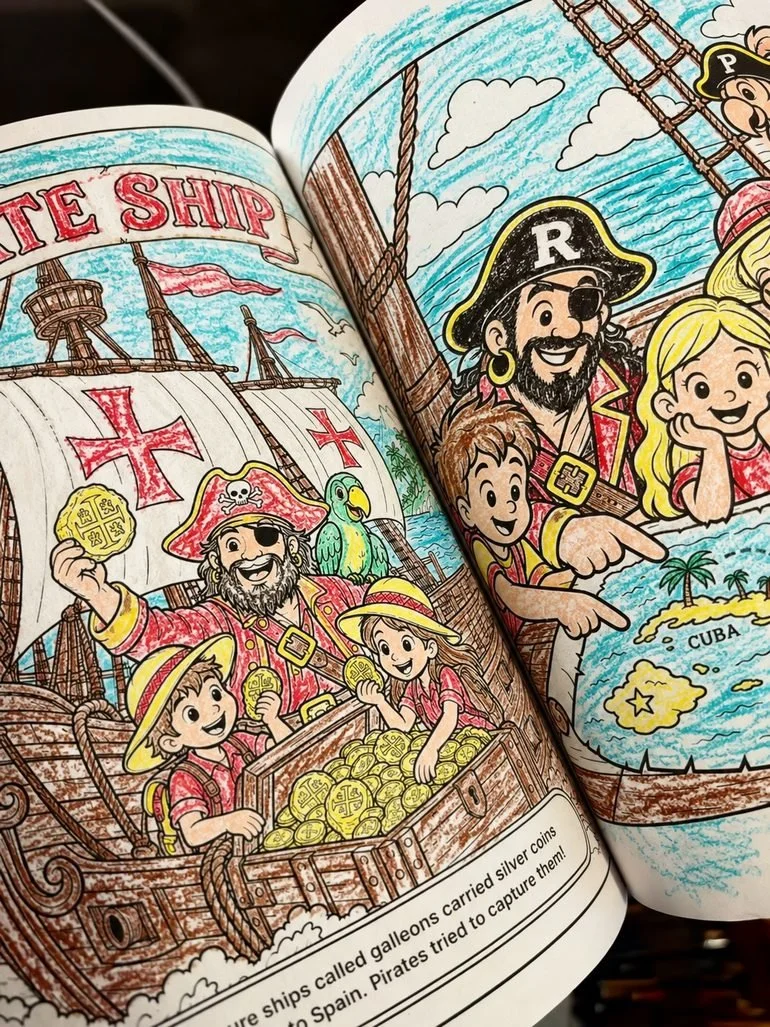
Coloring is how a child first learns to look at a coin the way a collector does: slowly, closely, with imagination.
The Moonlight Treasure
There is a second book now, for the little ones: The Moonlight Treasure, a bedtime story for ages 3–8.
Niko and Maya find a silver coin shining in the moonlight, and they sail off with Grandpa Leo, Pirate R and Peso on a gentle adventure about curiosity, kindness and family. It is a quieter book — a story to read before sleep — but it carries the same idea: a coin is never just a coin. It is the beginning of a story.
The Moonlight Treasure is available on Kindle ($4.99) and in paperback ($11.99) on Amazon.
Treasure Islands and the Explorer Club
The adventure does not stop at the last page.
On the website, children can play Treasure Islands: sail three islands with Grandpa and Captain R, dig up real coins, battle the crabs, earn reales, and beat the King Crab. Even the game teaches it — you earn, you keep, you decide what to do with what you have. That is managing money, in the form of play.
And families can join the Explorer Club — a free printable coloring page, plus the first news when Volume 2 sets sail.
Volume 2 is coming. The next adventure goes further — new coins, new countries, new stories.
For educators and families
I made this book for families, and for teachers and librarians too.
A coloring session can become a conversation about geography, about cultures, about the past — and about money. Start with the Americas. Find a country on a map. Discover the stories its coins can tell. Ask what a coin was worth, and what that meant for the people who used it. That is history, hands-on — not memorized, but discovered. And it is the beginning of financial literacy: understanding value, understanding saving, understanding that money has a story too.
Every coin has a story. When a child learns that, they never look at a coin the same way again.
Start your own treasure chest
And for the grown-ups reading this — the collectors, the parents, the grandparents — there is a next step.
The coins in the book are real, and real ones are waiting. At Collectorly, I hand-pick authentic Spanish colonial and Latin American coins, the same kind of pieces that inspired the book. Hold a piece of history. Start your own treasure chest.
A little discovery. A lifelong adventure.
I wrote Coin Adventures Kids because I went to the shows, I studied this world, and I saw what was missing: nothing for kids, and nothing teaching them about money.
I am an artist and a graphic designer. I drew this book with my own hands, from real coins I have held in my own hands. That is why it is real — the art, the history, and the story are all mine.
I believe the next generation of collectors is out there — six years old, twelve years old, sitting at a table with a crayon, coloring a ship, and wondering what is over the horizon.
Every coin has a story. This book is how the story begins.
Follow the adventure
Watch Coin Adventures Kids on YouTube, and follow along on Instagram and TikTok for new pages, new coins, and news about Volume 2.
Coin Adventures Kids, Volume 1: The Americas — ages 6–12, paperback, in English and Spanish. Available on Amazon. Discover the collection at coinadventureskids.com.
The Moonlight Treasure — a bedtime story, ages 3–8. Kindle $4.99, paperback $11.99, on Amazon.
Start your own treasure chest — authentic Spanish colonial and Latin American coins, hand-picked by the author, at Collectorly.
