

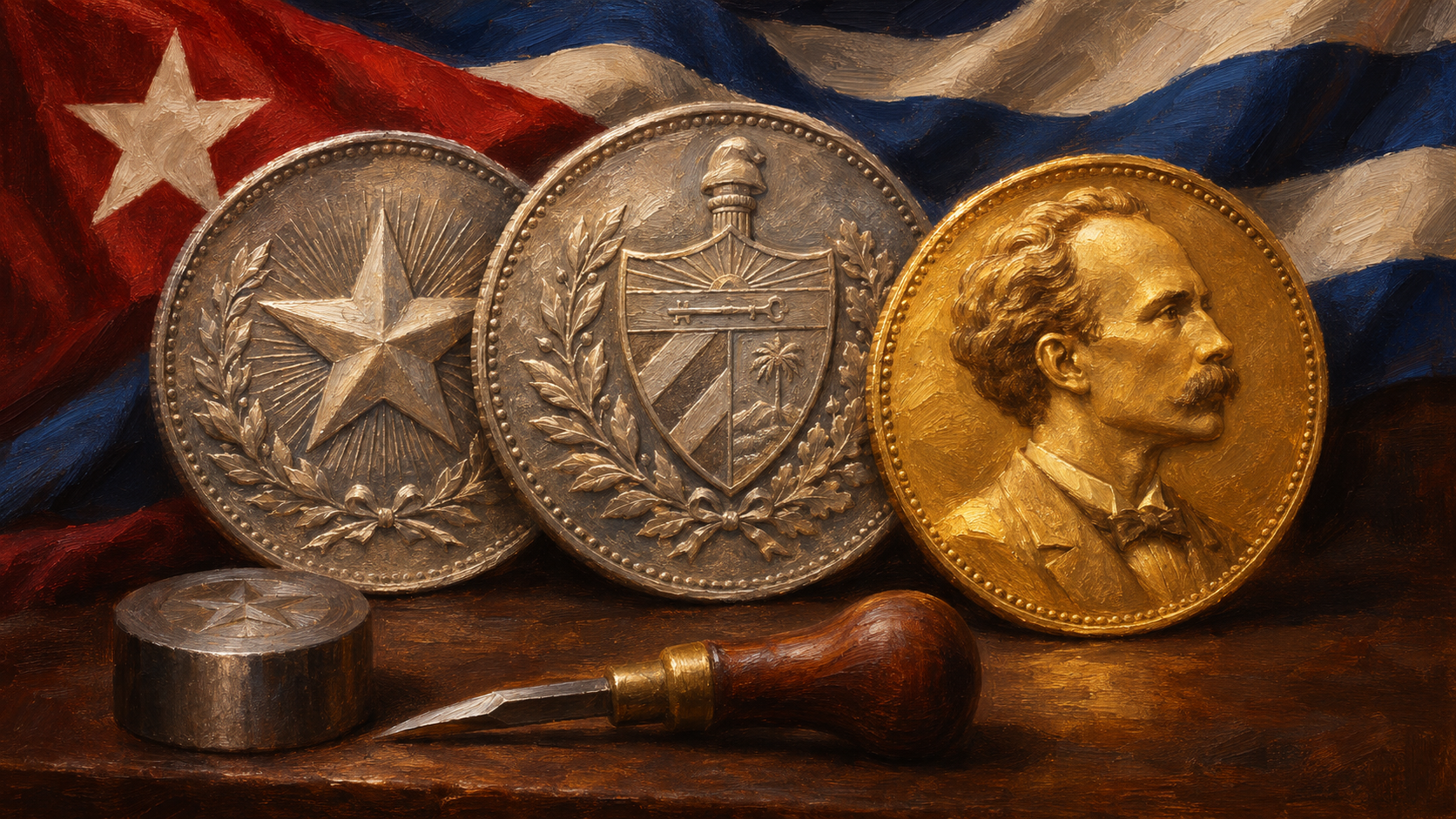
Cuba’s First National Coinage: The Historic Coins of 1915
The birth of a national currency, the artistry of Charles E. Barber, and the coins that became symbols of Cuban independence.
By Gian Franco Guerrieri | Collectorly — Numismatic History & Research
A New Republic, a New Currency
In 1915, the Republic of Cuba introduced its first national coinage, marking a defining moment in the country’s monetary history.
Although Cuba had achieved formal independence in 1902, its economy continued to rely heavily on foreign currency, particularly that of the United States. The creation of a national coinage was therefore more than a practical economic decision. It represented a young republic’s desire to establish its own monetary identity.
On October 29, 1914, legislation under President Mario García Menocal authorized the development of Cuba’s national coinage.
Without a domestic mint equipped to produce the required coins, Cuba turned to the United States. The Philadelphia Mint would manufacture the new currency, while the designs would incorporate the symbols and ideals of the Cuban Republic.
The project brought together Cuban officials, American monetary advisers, and one of the most accomplished engravers of his generation: Charles E. Barber.
The result was an extraordinary series of copper-nickel, silver, and gold coins whose designs would become inseparable from Cuba’s numismatic identity.
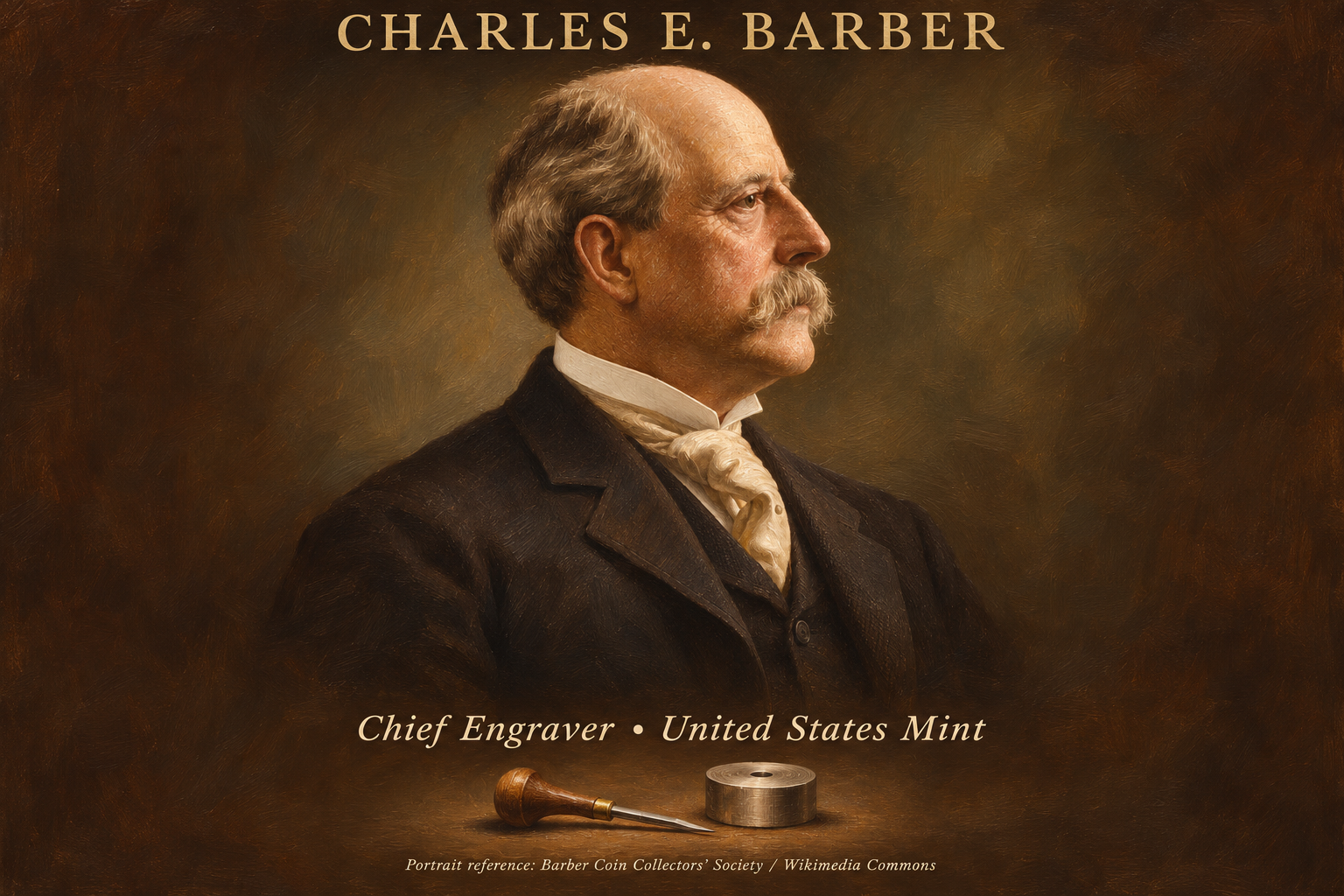
Charles E. Barber, Chief Engraver of the United States
The Men Behind Cuba’s First Coins
Mint from 1879 until 1917, is best remembered for the American dime, quarter, and half dollar that bear his name.
His contribution to Cuban coinage, however, deserves equal recognition.
Historical correspondence reveals that Barber worked closely with Charles A. Conant, Cuban financial officials Leopoldo Cancio and Eduardo I. Montoulieu, and other individuals involved in the project.
Montoulieu played a particularly important role in developing the proposed designs and coordinating the minting process.
The surviving letters document discussions about artistic details, coin dimensions, relief, and the representation of José Martí.
On March 9, 1915, Barber and Cuban representatives witnessed the striking of the first Cuban national coin, a 10 Centavos, at the Philadelphia Mint.
The first shipment of coins reached Havana in April 1915.
These details remind us that the creation of a national currency was not the work of a single artist, but the result of collaboration between two countries and numerous individuals.
The Designs: Patria y Libertad
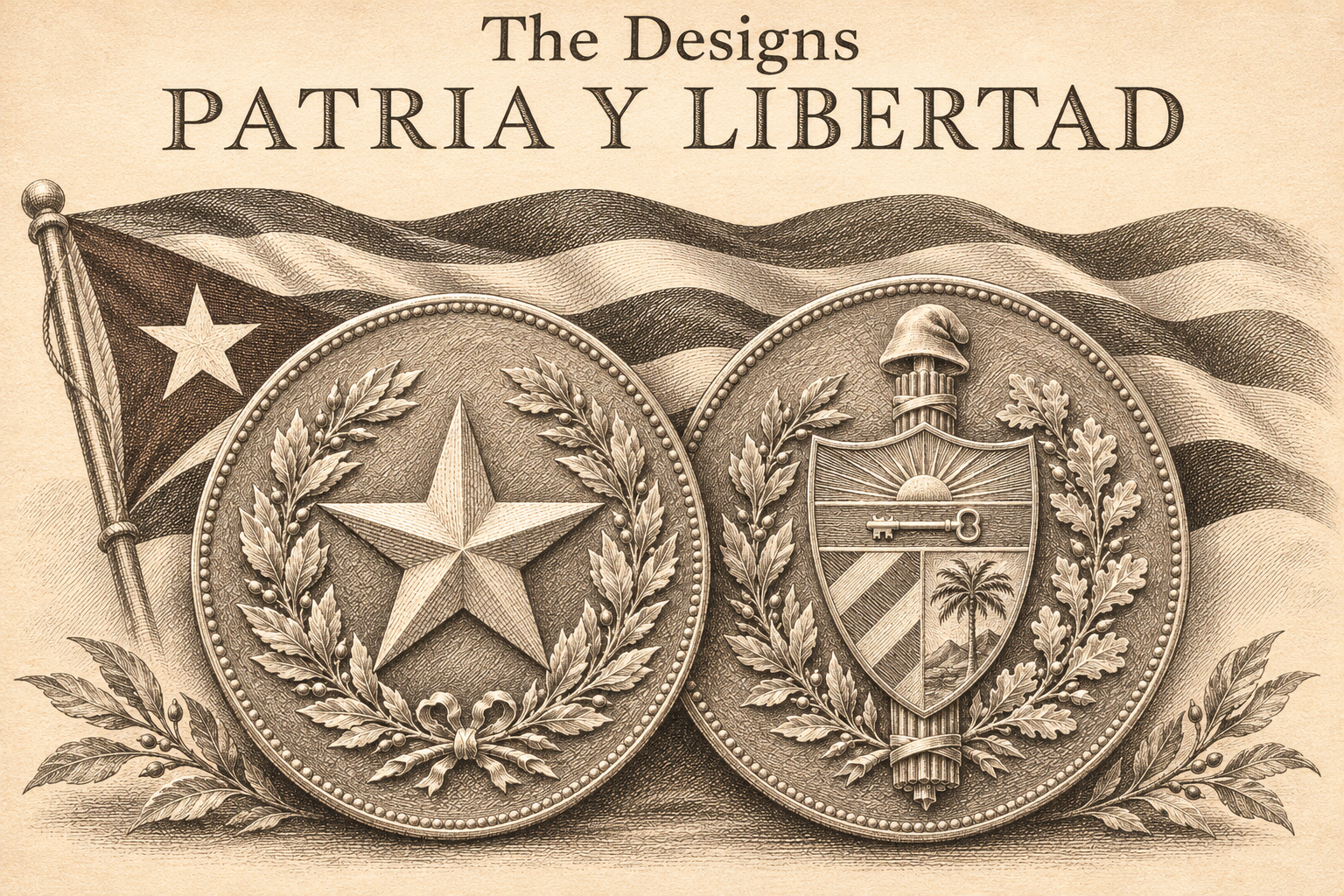
The Designs: Patria y Libertad
The new coinage was intended to communicate Cuba’s national identity through carefully selected symbols.
The silver coins featured the Cuban coat of arms and a prominent five-pointed star surrounded by radiating lines.
The inscription PATRIA Y LIBERTAD — Fatherland and Liberty expressed the ideals associated with Cuba’s struggle for independence.
The national coat of arms incorporated several important elements, including the royal palm, the key between two landmasses, and the Phrygian cap, traditionally associated with liberty.
The gold coins introduced another powerful image: the portrait of José Martí.
Martí, the poet, writer, intellectual, and revolutionary leader who died in 1895, became one of the most enduring figures in Cuban national history.
By placing his portrait on the new gold coinage, the republic connected its monetary system to the memory of its independence movement.
Barber translated these national symbols into designs suitable for coin production, combining technical precision with a distinctive Cuban identity.
The 1915 Silver Coinage
The inaugural silver coinage included four denominations, all struck in .900 fine silver.
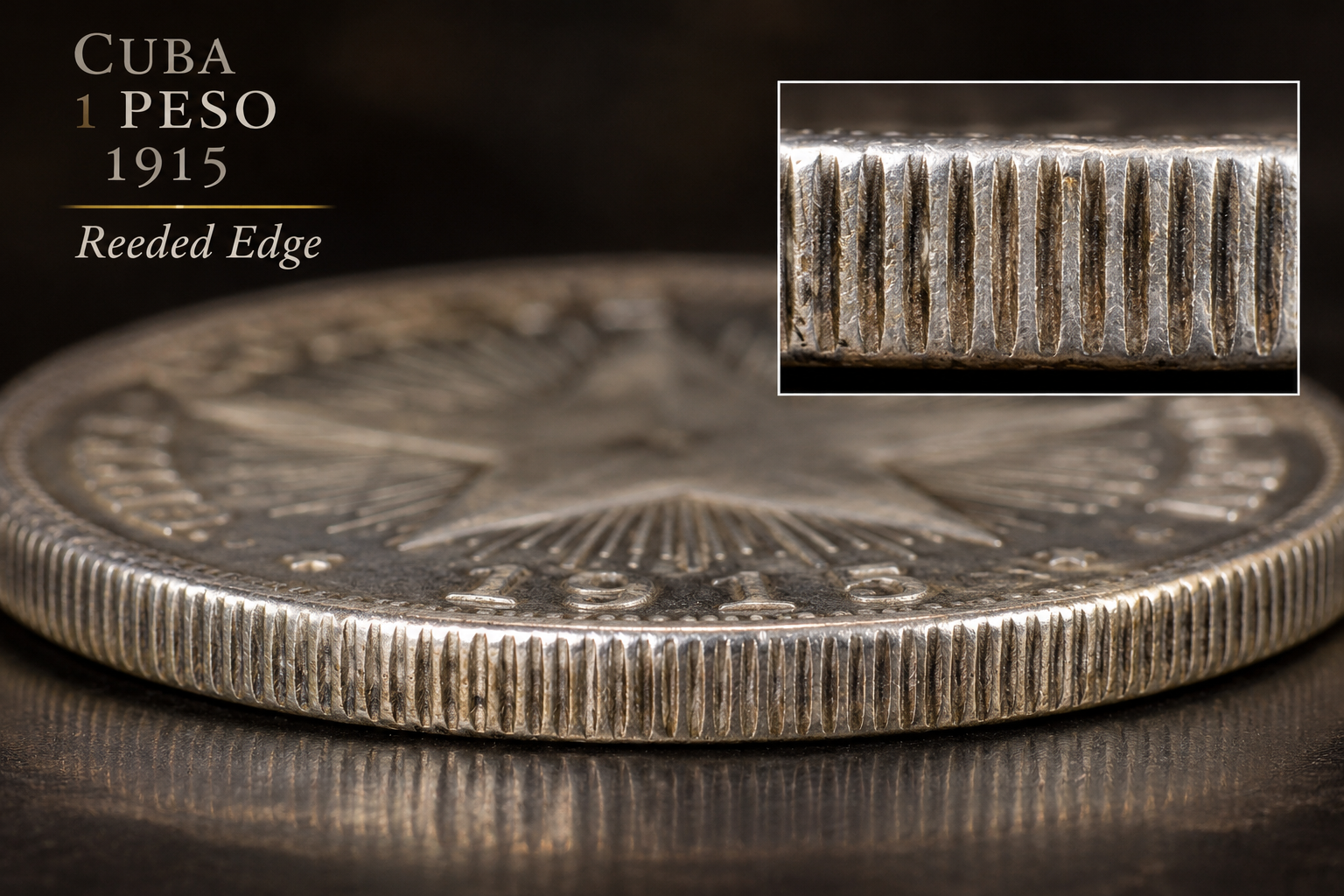
Reeded Edge
Denomination Silver fineness
Standard weight
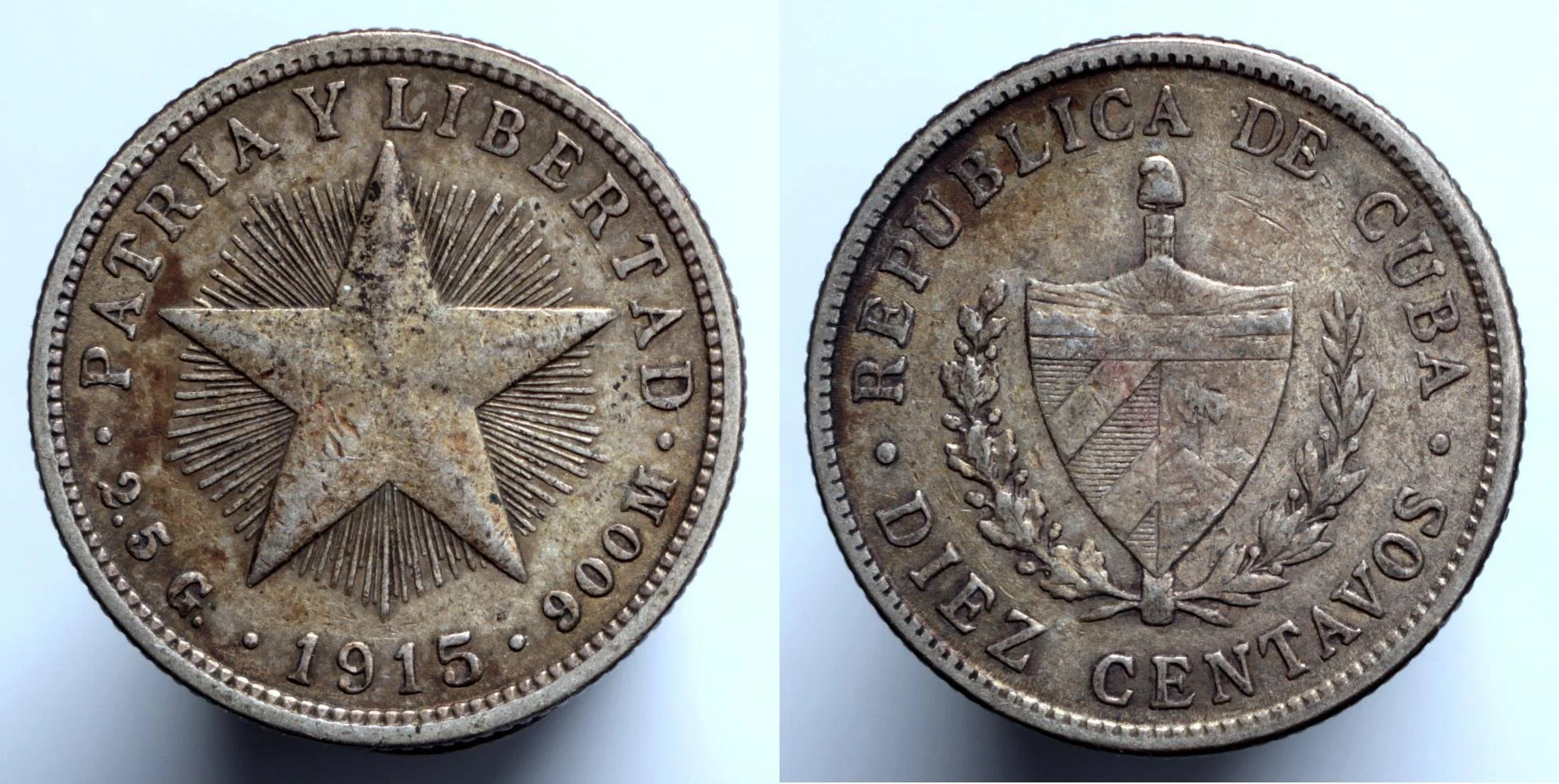
10 Centavos
Silver fineness: .900
Standard weight: 2.5 g
M-A12 · 2.5 g · 17.8 mm
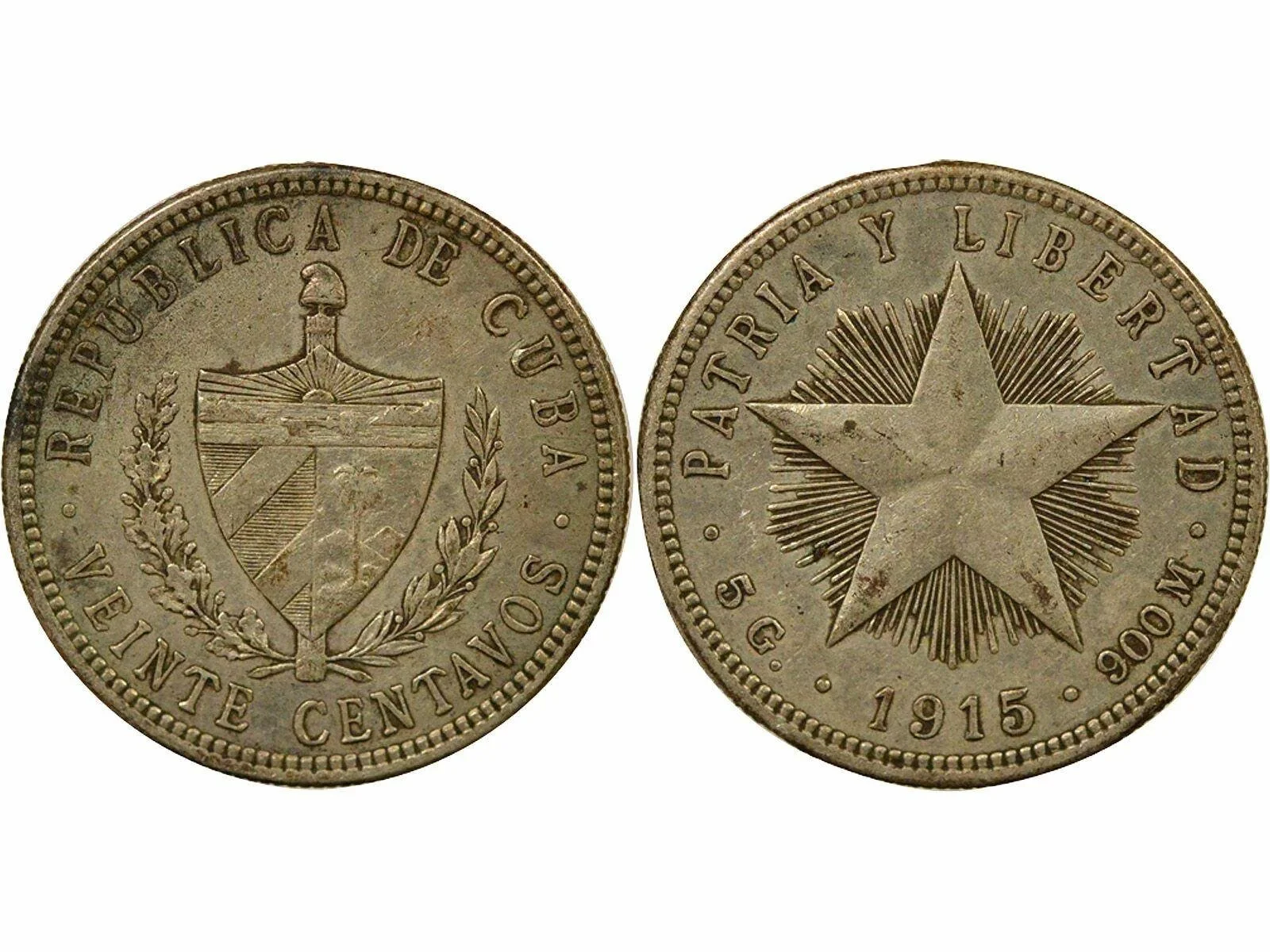
20 Centavos
Silver fineness: .900
Standard weight: 5 g
KM-13 · 5 g · 23 mm
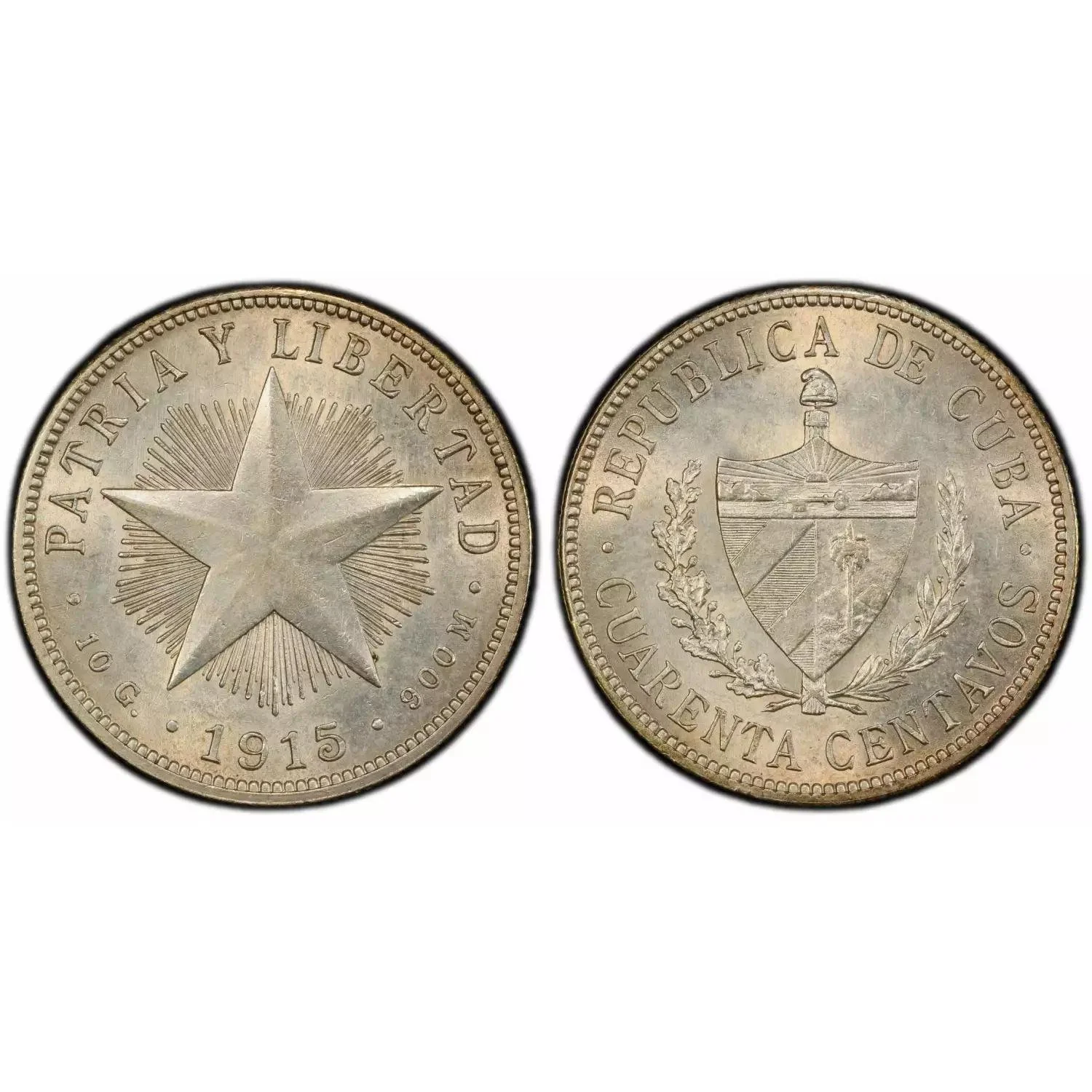
1 Peso
Silver fineness: .900
Standard weight: 26.7295 g
KM-15.1 / KM-15.2 · 26.7295 g
The smaller silver denominations followed a proportional weight standard, while the peso shared the weight and fineness of the contemporary United States silver dollar.
The smaller silver denominations followed a proportional weight system, while the peso was produced to the silver-content standard associated with the contemporary United States dollar.
These coins were intended for practical circulation, but their designs also represented a significant departure from the foreign currency that had previously dominated Cuban commerce.
Today, the series offers collectors a fascinating combination of historical importance, distinctive design, and specialized varieties.
The 1915 Cuban Star Peso
Among the most recognizable coins of Cuba’s first national series is the 1915 silver peso, widely known as the Star Peso.
The coin’s most striking feature is its large five-pointed star, surrounded by radiating lines and the inscription Patria y Libertad.
The opposite side features the Cuban national coat of arms.
Its broad silver surfaces and bold geometric design make it one of the most visually distinctive coins of early twentieth-century Latin America.
Technical Specifications
1915 Cuban Star Peso — Technical
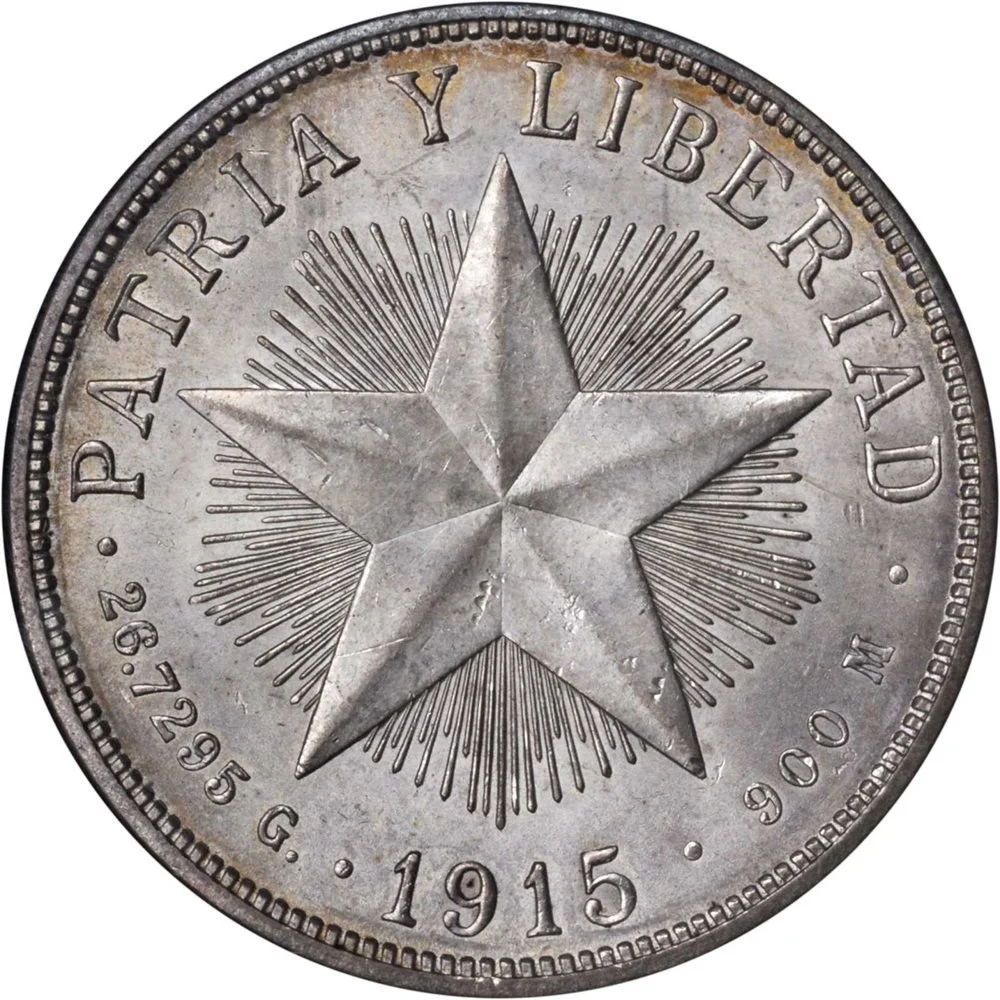
Image by heritage auctions
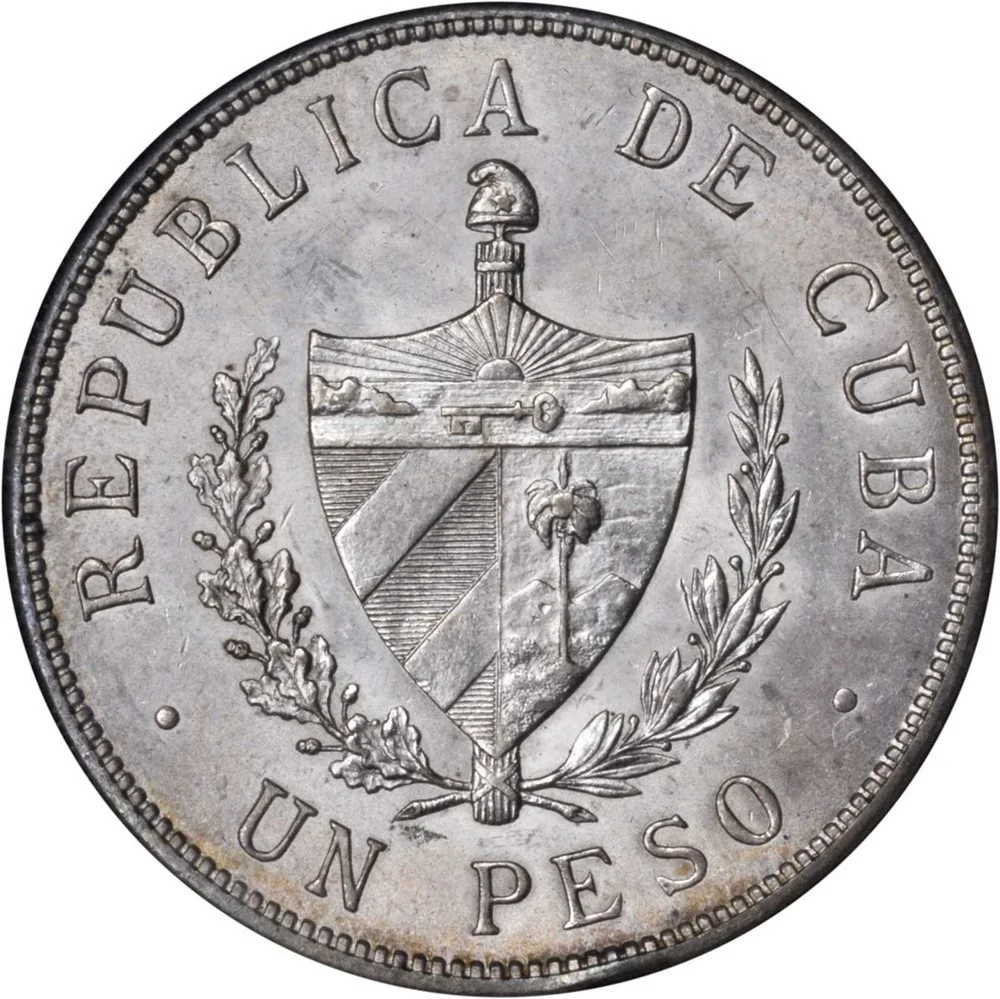
Image by heritage auctions
Specifications
Country: Republic of Cuba
Year: 1915
Mint: Philadelphia, United States
Designer: Charles E. Barber
Composition: 90% silver, 10% copper
Standard Weight: 26.7295 grams
Diameter: 38 mm
Actual Silver Weight: 0.7734 troy ounces
Edge: Reeded
Catalog References: KM-15.1 (High Relief) and KM-15.2 (Low Relief)
Recorded Circulation Mintage: 1,976,000 pieces
Numismatic references also record 100 Proof examples of the 1915 high-relief peso.
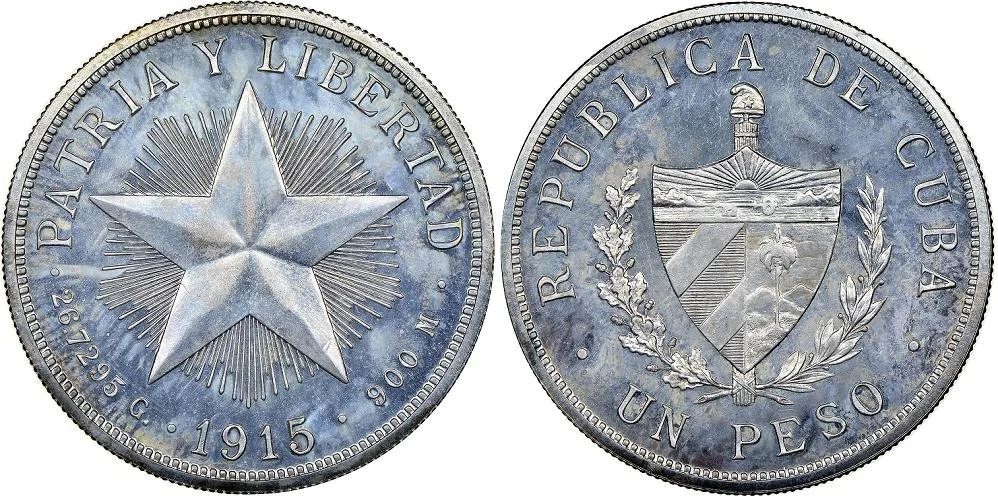
High Relief Star — KM-15.1
The star has stronger sculptural depth, with more rounded transitions between its raised facets.
The published circulation mintage should not be confused with the number of surviving coins. Circulation, melting, damage, and other factors have influenced the number available to collectors today.
High Relief and Low Relief: The Star Varieties
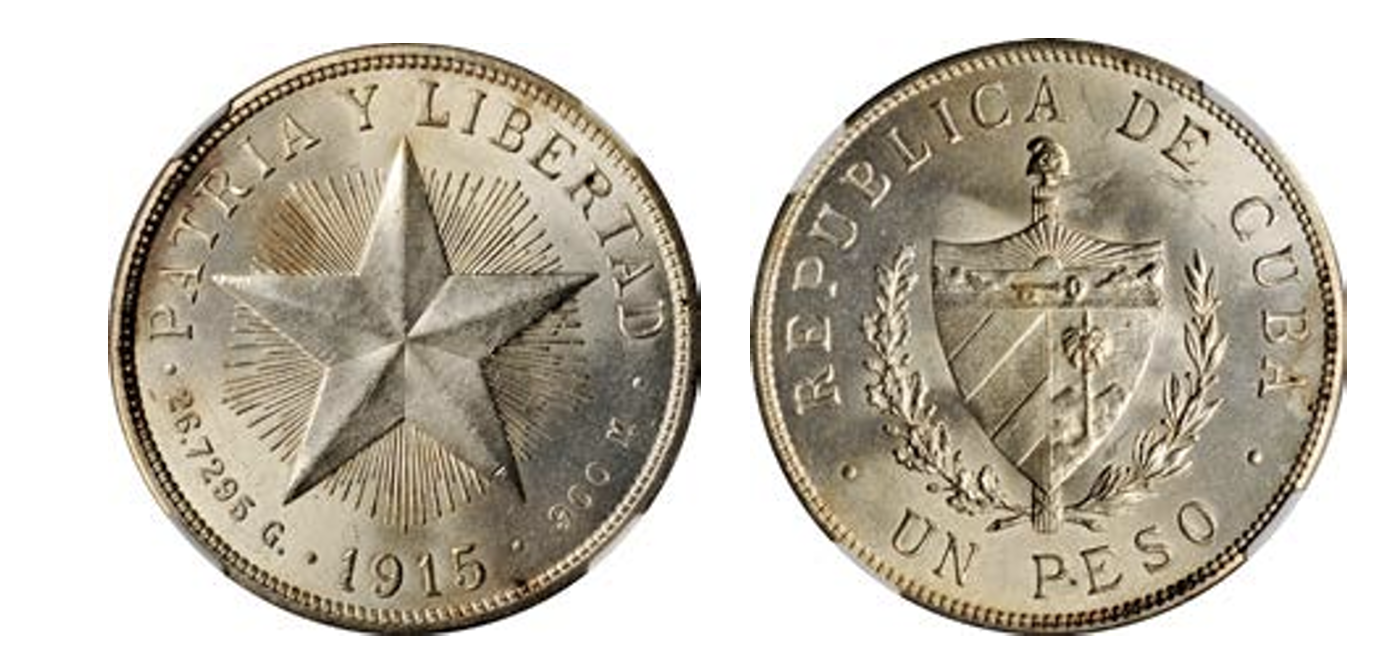
Low Relief Star variety KM-15.2.
One of the most interesting aspects of the 1915 Cuban peso is the existence of two principal star-relief varieties.
High Relief Star — KM-15.1
The high-relief variety displays a more pronounced central star, with softer transitions in the surrounding design.
These coins can also exhibit areas of weakness in the coat of arms, particularly around the key and palm tree.
The high-relief design is especially appealing to collectors interested in the artistic and technical development of the first Cuban peso.
The low-relief variety features a flatter star, with more clearly defined lines extending toward its center.
The differences can be subtle, particularly on circulated examples where wear may obscure the original relief.
Careful examination of the star, surrounding rays, and corresponding details on the coat of arms is important for accurate attribution.
The existence of these varieties illustrates how adjustments in relief and die preparation can create meaningful distinctions within a single year’s coinage.
Collectors should also be aware of additional specialized varieties, including the scarce high-relief peso without periods in portions of its inscription.
The published 1915 circulation mintage should not be assigned separately to the two principal relief varieties without supporting documentation.
Beyond Silver: Cuba’s First Gold Coinage
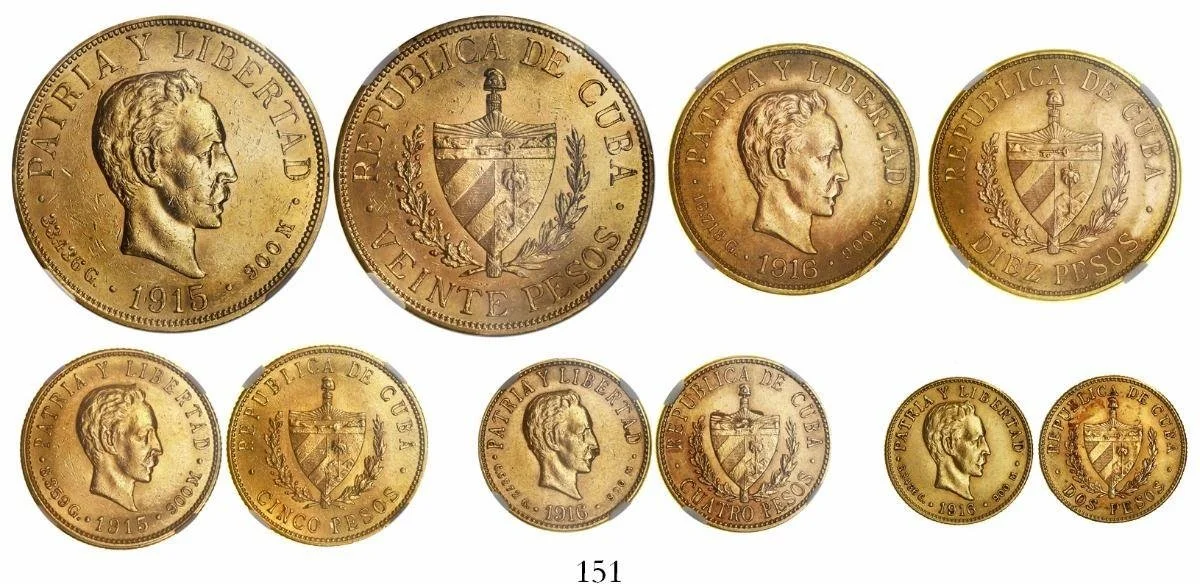
Excellent historical reference: PCGS — Republic of Cuba Coinage: The Men Who Made It Happen
The new republic also introduced an extraordinary series of gold coins bearing the portrait of José Martí.
Six denominations were produced:
1, 2, 4, 5, 10, and 20 Pesos.
These coins were struck in .900 fine gold at the Philadelphia Mint.
Their designs reflected both the technical standards of American gold coinage and the national symbolism of Cuba.
The portrait of Martí appeared alongside the inscription Patria y Libertad, while the opposite side displayed the Cuban coat of arms and the denomination.
The gold series is particularly important because it commemorates Cuba’s national identity through the image of one of its most influential historical figures.
The 1915 Gold 5 Pesos
The 1915 Gold 5 Pesos is one of the most recognizable denominations of the series.
Feature Description
The 1915 Gold 5 Pesos
The 1915 Gold 5 Pesos is one of the most recognizable denominations of Cuba’s first national gold coinage.
Date: 1915
Denomination: 5 Pesos
Catalog Reference: KM-19
Composition: 90% gold, 10% copper
Standard Weight: 8.3592 grams
Actual Gold Weight: 0.2419 troy ounces
Diameter: Approximately 21.6 mm
Designer: Charles E. Barber
Mint: Philadelphia, United States
Recorded Mintage: 696,000 pieces
The 5 Pesos combines a beautifully engraved portrait of José Martí with the Cuban national coat of arms.
Its historical significance extends beyond its precious-metal content. It represents Cuba’s early monetary independence and the enduring legacy of Martí.
Special Proof and Specimen examples of the inaugural gold series are also known, adding another dimension to the study of these remarkable coins.
The 5 Pesos combines a beautifully engraved portrait of Martí with the national coat of arms.
Its historical significance extends beyond its precious-metal content. It represents the early years of Cuba’s monetary independence and the enduring legacy of Martí.
Special Proof and Specimen examples of the inaugural gold series are also known, adding another dimension to the study of these remarkable coins.
What Collectors Should Look For
The Cuban coinage of 1915 offers opportunities for both beginning and advanced collectors.
For the silver peso, identifying the correct star-relief variety is essential. Collectors should carefully examine the star, the surrounding rays, and the corresponding details of the coat of arms.
Surface originality, natural luster, strike quality, and evidence of cleaning or alteration are equally important.
The smaller silver denominations also offer interesting varieties, while the copper-nickel issues provide an accessible introduction to Cuba’s first national coinage.
In the gold series, collectors often focus on the preservation of Martí’s portrait, the quality of the surfaces, and the distinction between circulation strikes and specially prepared examples.
Certified population reports from PCGS and NGC can help assess condition rarity, but they must be interpreted carefully. Certification totals are not equivalent to the complete surviving population, and resubmissions can affect reported numbers.
Ultimately, understanding the historical context, original mintage, surviving condition, and recognized varieties is essential to appreciating these coins.
A Personal Connection to Cuban Numismatics
Living in South Florida has given me the opportunity to connect with a remarkable community of Cuban and Caribbean collectors who share my passion for numismatics.
One of those individuals is Eli Benítez, known as AKA “The Cuban Pitaré,” a fellow collector and numismatist whose knowledge, enthusiasm, and dedication to Cuban coinage I greatly appreciate.
Through our conversations, he has generously shared his knowledge, perspectives, and passion for preserving Cuba’s numismatic heritage.
These exchanges have reminded me that collecting is about much more than acquiring coins. It is about the friendships we build, the stories we discover, and the knowledge we share with one another.
My own connection to Cuban numismatics began with a 1915 Cuba Gold 5 Pesos, the first Cuban coin I purchased for my personal collection.
The portrait of José Martí, the beauty of Barber’s engraving, and the historical significance of the coin inspired me to learn more about Cuba’s early national currency.
That interest naturally led me to explore the celebrated 1915 Star Peso and the wider history of Cuban coinage.
For me, these coins represent more than precious metals or collectible objects. They are tangible connections to a nation’s history, its people, and its identity.
The opportunity to share this passion with fellow collectors, especially those with deep personal connections to Cuba, continues to be one of the most rewarding aspects of numismatics.
A Lasting Legacy
More than a century after their introduction, the Cuban coins of 1915 remain among the most historically meaningful issues of the Caribbean.
They represent the establishment of a national monetary identity, the craftsmanship of the Philadelphia Mint, and the aspirations of a republic expressing its independence through coinage.
From the modest centavo to the celebrated Star Peso and the gold portraits of José Martí, each denomination preserves a chapter of Cuba’s history.
These coins also remind us that numismatics is not only the study of currency. It is the study of people, nations, artistic traditions, and the historical circumstances that shape them.
At Collectorly, we believe that understanding the history behind a coin is essential to appreciating its true numismatic significance.
Curating Value, Preserving History.
Gian Franco Guerrieri
Collectorly — Latin American & Caribbean Numismatics
