

By Gian Franco Guerrieri, numismatist and artist
A Design You Don't Forget
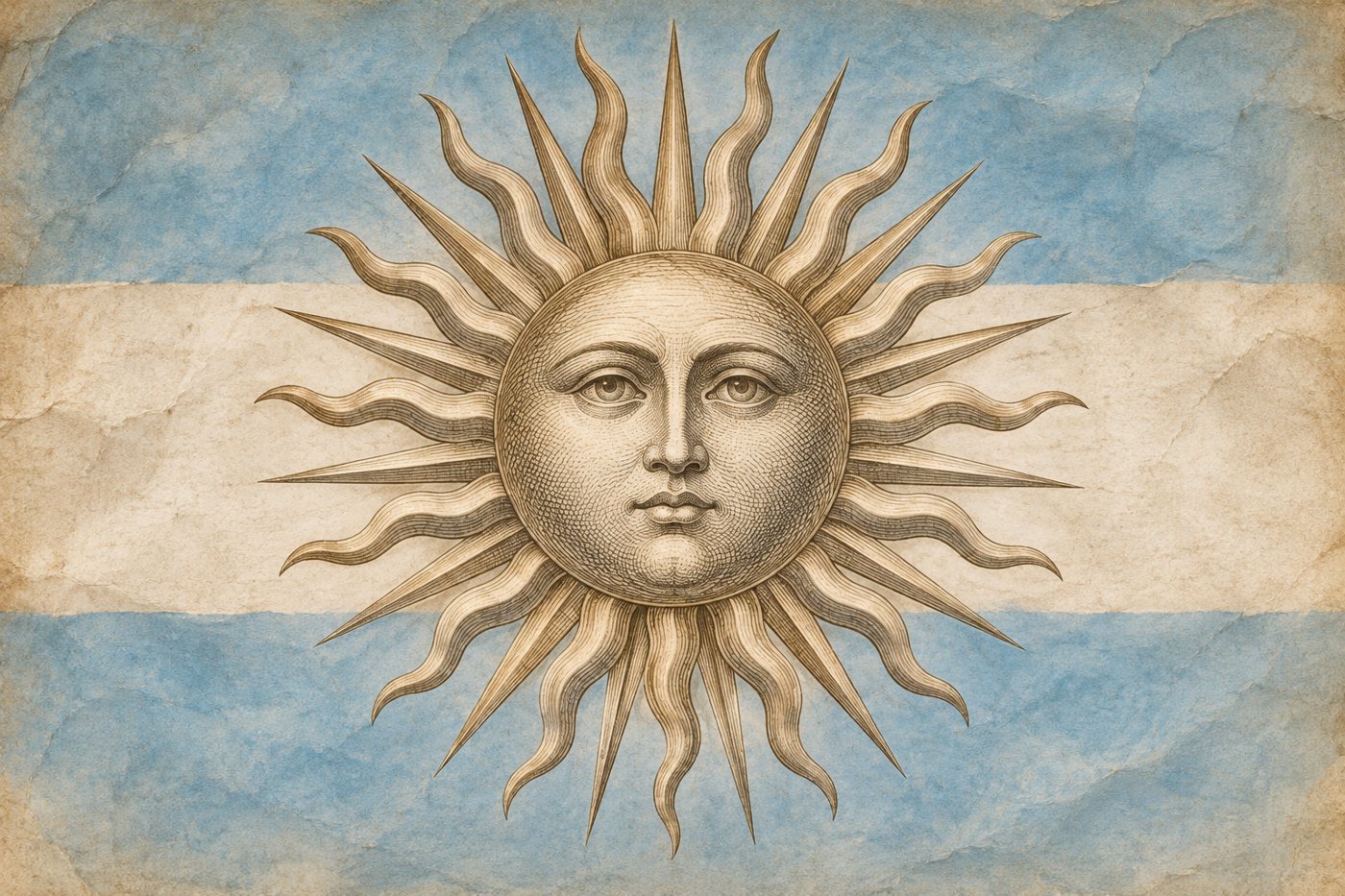
Some designs stay with you. For me, it's the Argentine sun and the flag it sits on. I've been traveling to Argentina since I was young, and long before I ever held one of these coins, I saw that sun everywhere: on buildings, on banners, on the Argentine soccer jersey, in the sky-blue and white of the flag. As an artist, I've always thought of it as one of the greatest national designs ever made. It's simple and bold, and it has a face full of character.
The Sol de Mayo, the May Sun, recalls the May Revolution of 1810, when Buenos Aires took its first step toward independence. Within a few years, that sun would move from banners onto silver.
According to tradition, the sun broke through the clouds on May 25, 1810, during the cabildo, and the image became the sun of a new nation. Historians treat that story as tradition rather than documented fact, but it explains why the sun still stands for the birth of Argentina.
Where It Began: Potosí, 1813
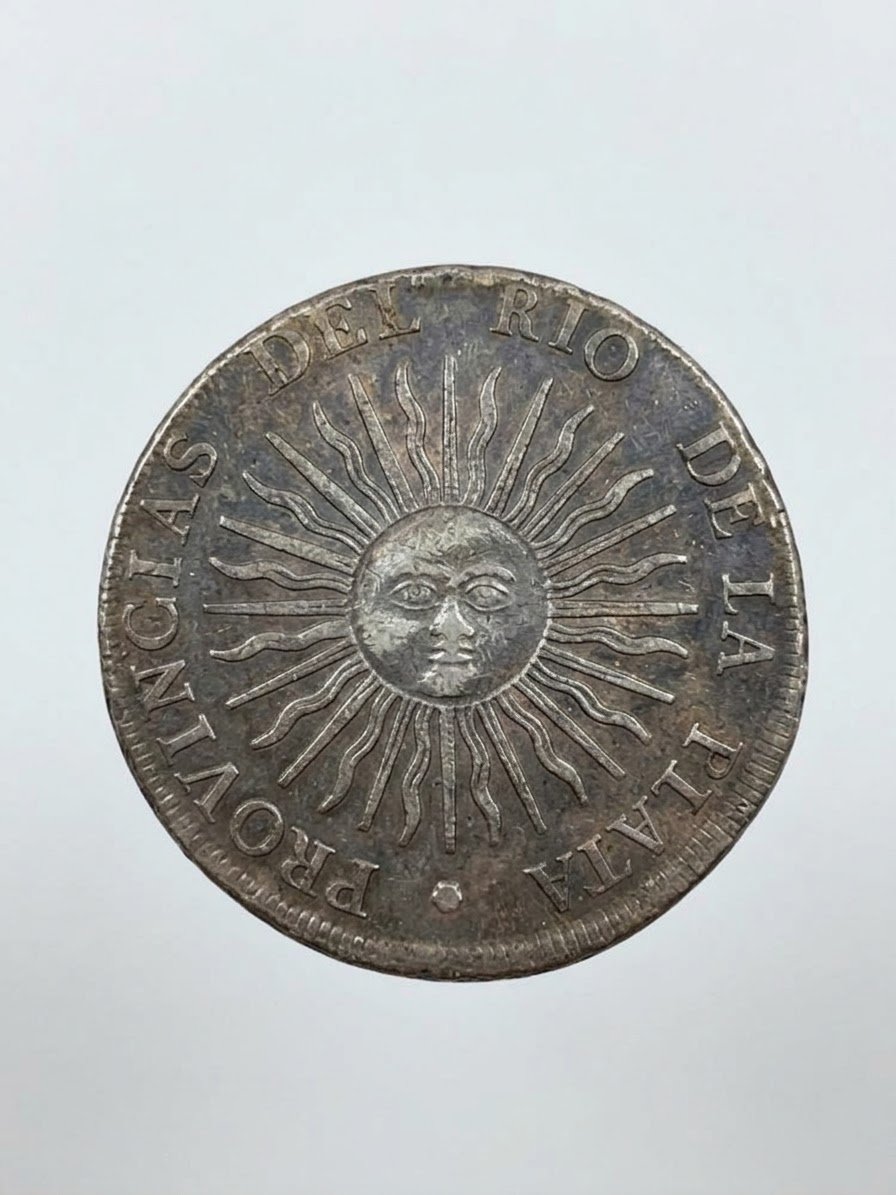
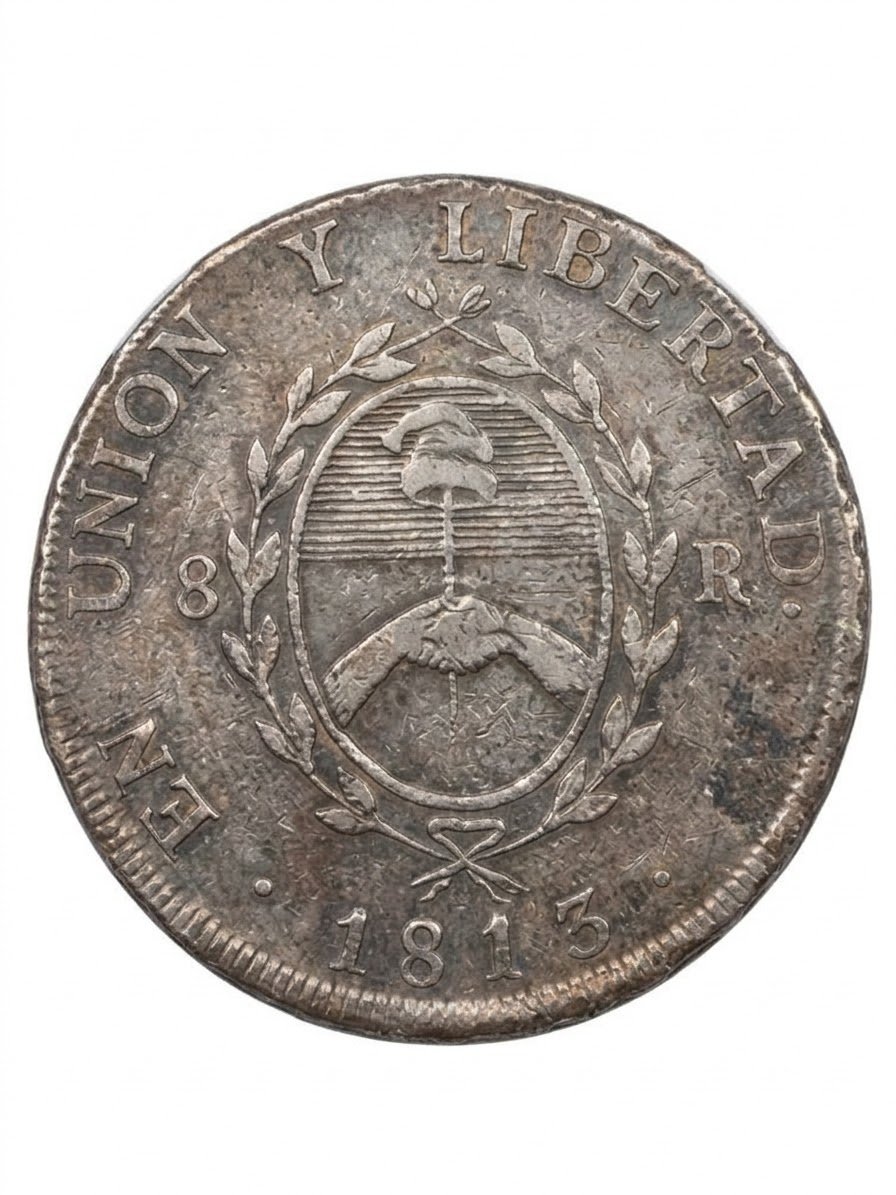
My 1813 Potosí 8 reales (PTS J), graded XF40 by NGC. Argentina's first national coin, from my private collection.
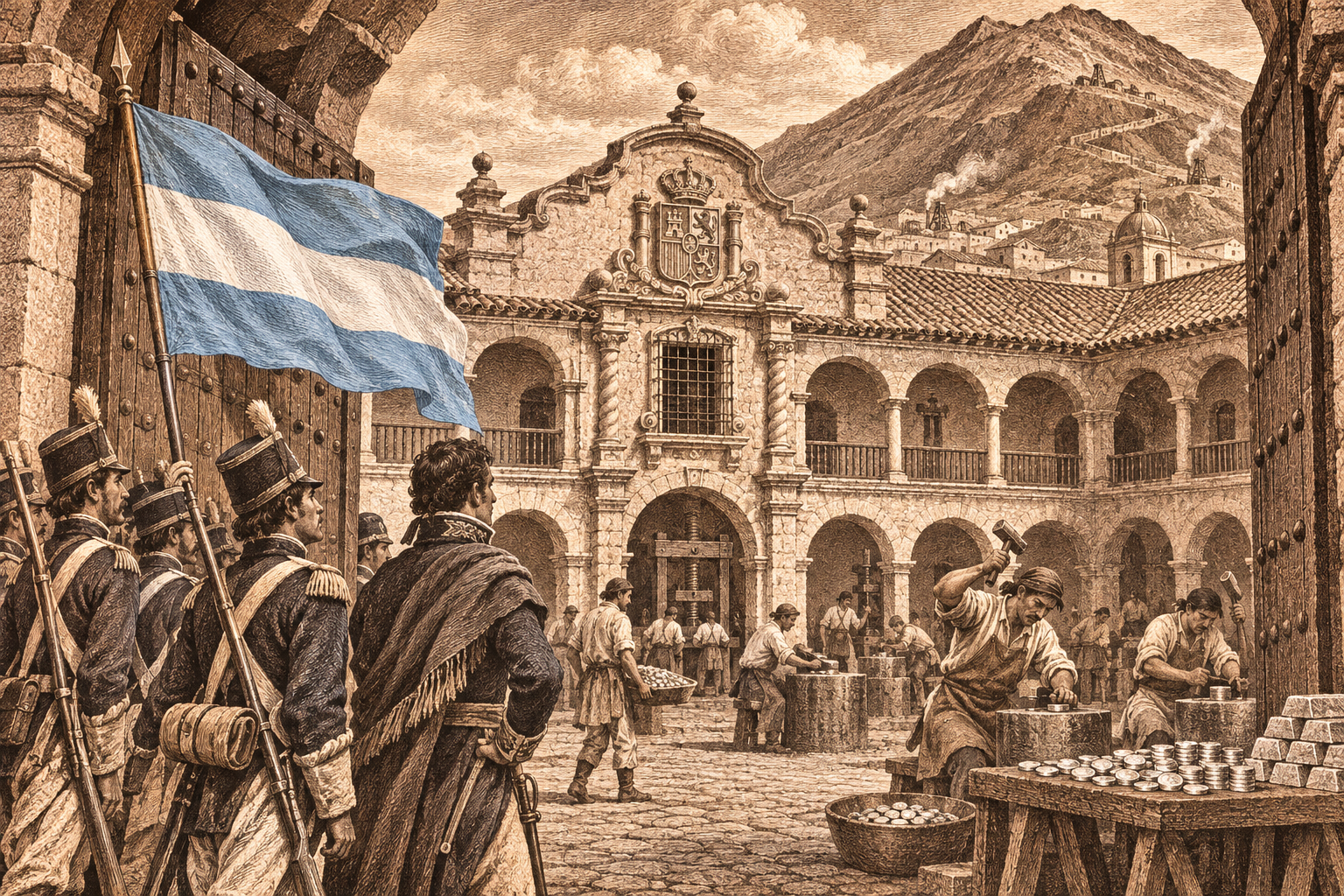
The sun first appeared on a coin in 1813. After the patriot victory at Salta, Belgrano's Army of the North occupied Potosí on May 7 of that year. The Asamblea del Año XIII, by a law of April 13, ordered him to restart the plundered mint and strike coins with the new national symbols (Exonumia y Numismática; Dólar Hoy). The sun first appeared on the Assembly's seal and then on these coins, and it was later carried onto the flag (Canal 26). The engraving and striking were the work of Pedro Benavídez, chief engraver of the Potosí mint (HCD Corrientes).
The run was short. The defeats at Vilcapugio and Ayohuma forced the patriots to leave Potosí. They returned briefly in 1815 and struck soles and reales in silver, which today are more common than the 1813 coins (Billetes Argentinos). The design survived, and it went on to become the face of a nation's money.
One of the pieces I treasure most in my own collection is an 1813 PTS J 8 reales, graded XF40 by NGC. It is Argentina's first national coin, struck at Potosí during that short patriot window, and the Sol de Mayo still shines bright and clear on it. Holding it, I'm holding the very first time that sun was ever put into silver.
The Sun Moves to the Provinces: La Rioja
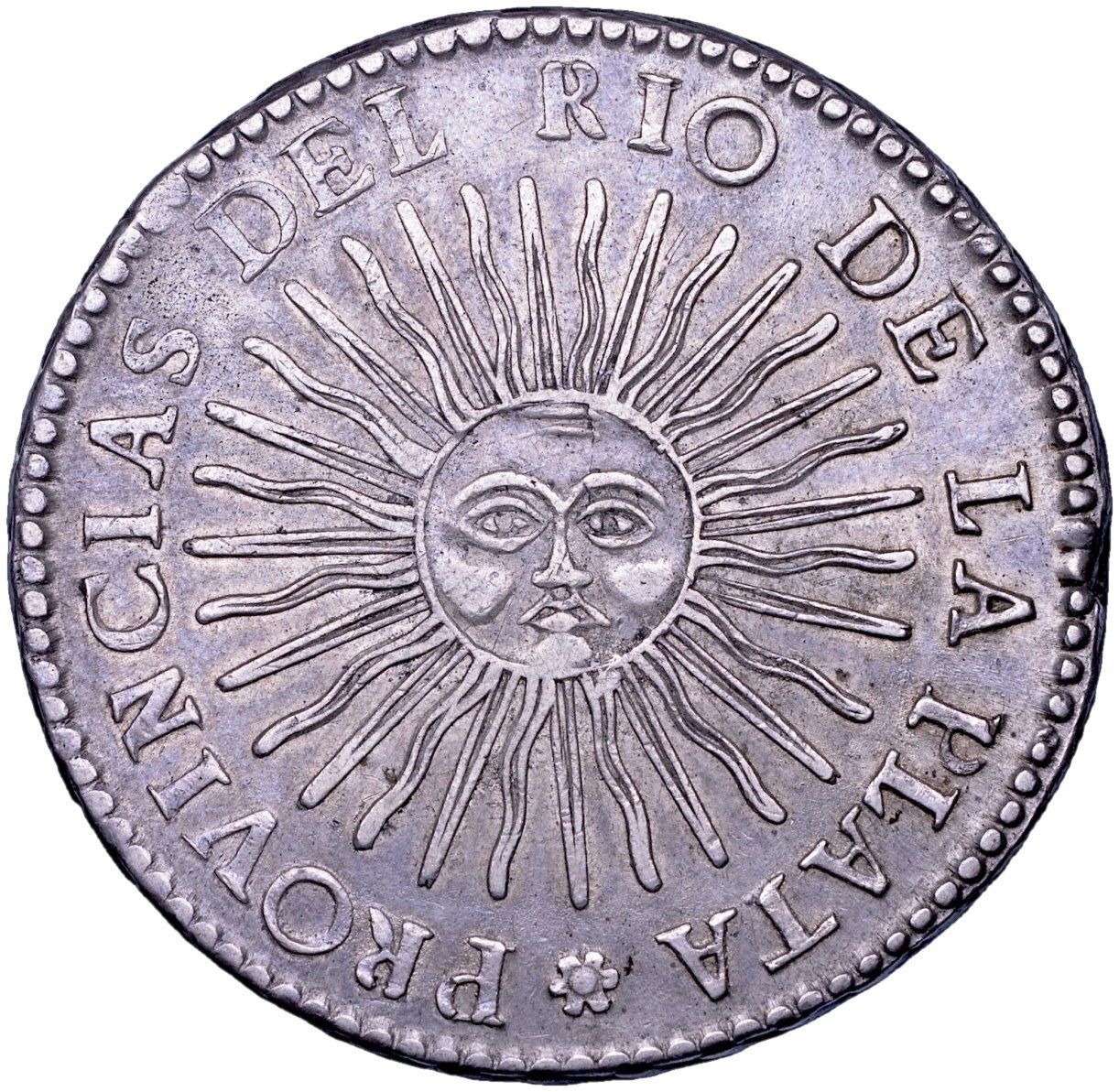
1831 La Rioja 8 reales. The sun's face is calm and detailed, and the rays wave outward around it.
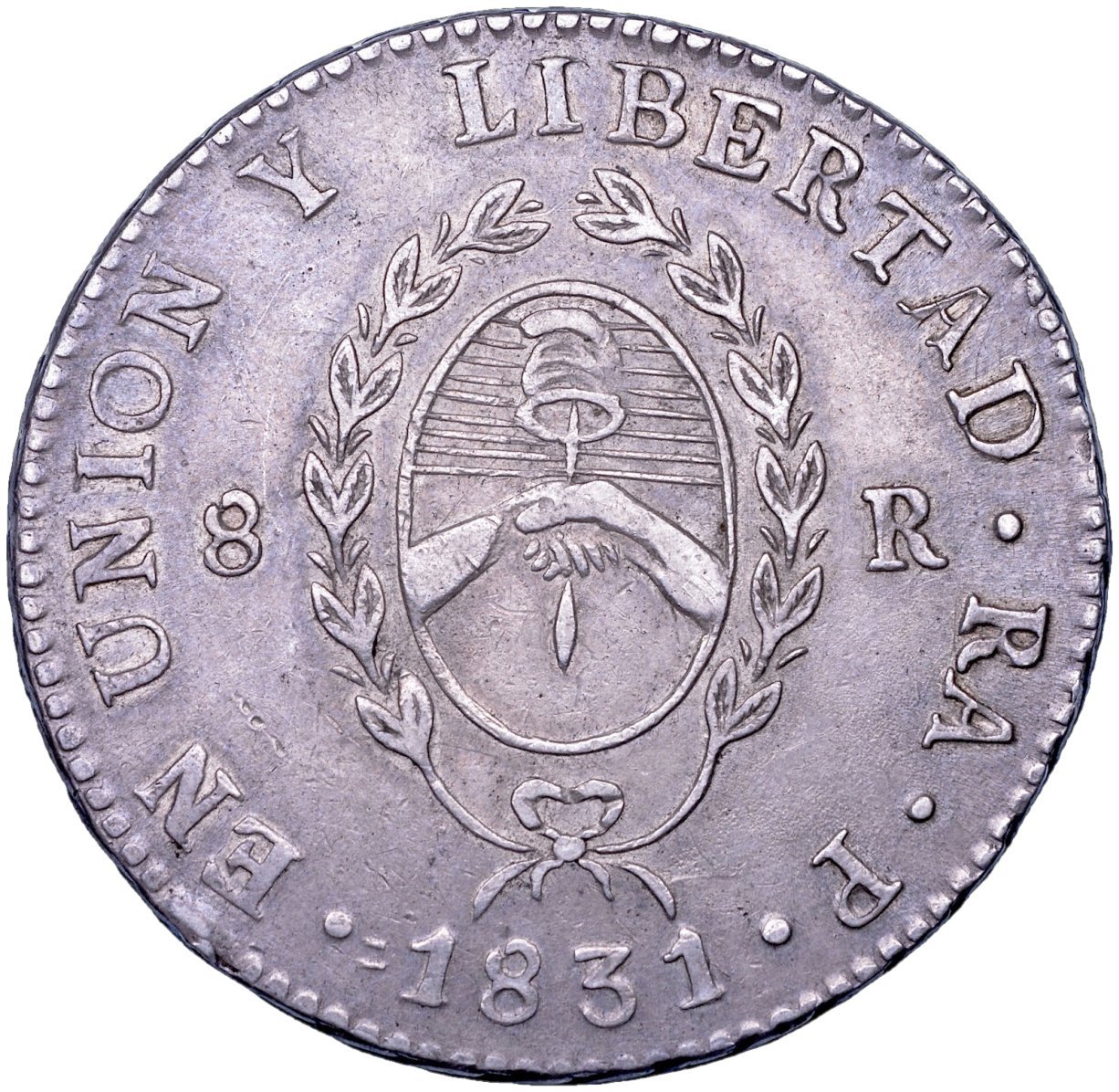
Reverse: the coat of arms inside a laurel wreath with EN UNION Y LIBERTAD.
Without Potosí, the sun moved into the provinces. In 1824 the province founded its own mint at La Rioja, using a design modeled on the patriotic Potosí coinage and the name of the United Provinces, so its coins could circulate nationally (Billetes Argentinos). Its silver and gold came from the Famatina mines, and it was the first mint to strike gold in what is now Argentina (Blog Numismático). Its first coining machine was even built with bronze sent by the province of Córdoba (Todo Argentina). La Rioja's engravers gave the sun a personality all its own. Every sun-face coin from those decades looks a little different, almost like a portrait.
One of my favorites is a La Rioja 2 soles from 1826. It's a well-worn VG10, struck with medal alignment, which means both sides face the same way when you turn the coin. After almost two centuries in circulation, the sun is still the star. Its face is bold and graphic, almost like a poster. To me, that's the best proof of how strong the design is. Even worn down, it still speaks. My first La Rioja coin came to me through the Argentine numismatist Ariel Dabbah, who introduced me to it at a coin show. His colleague at Río de la Plata, Alejandro Gutiérrez, has been a great teacher to me as well.
My 1826 La Rioja 2 soles, graded VG10 by NGC, with medal alignment. The wide-eyed sun has the feel of folk art.
Córdoba: A Castle Under the Sun
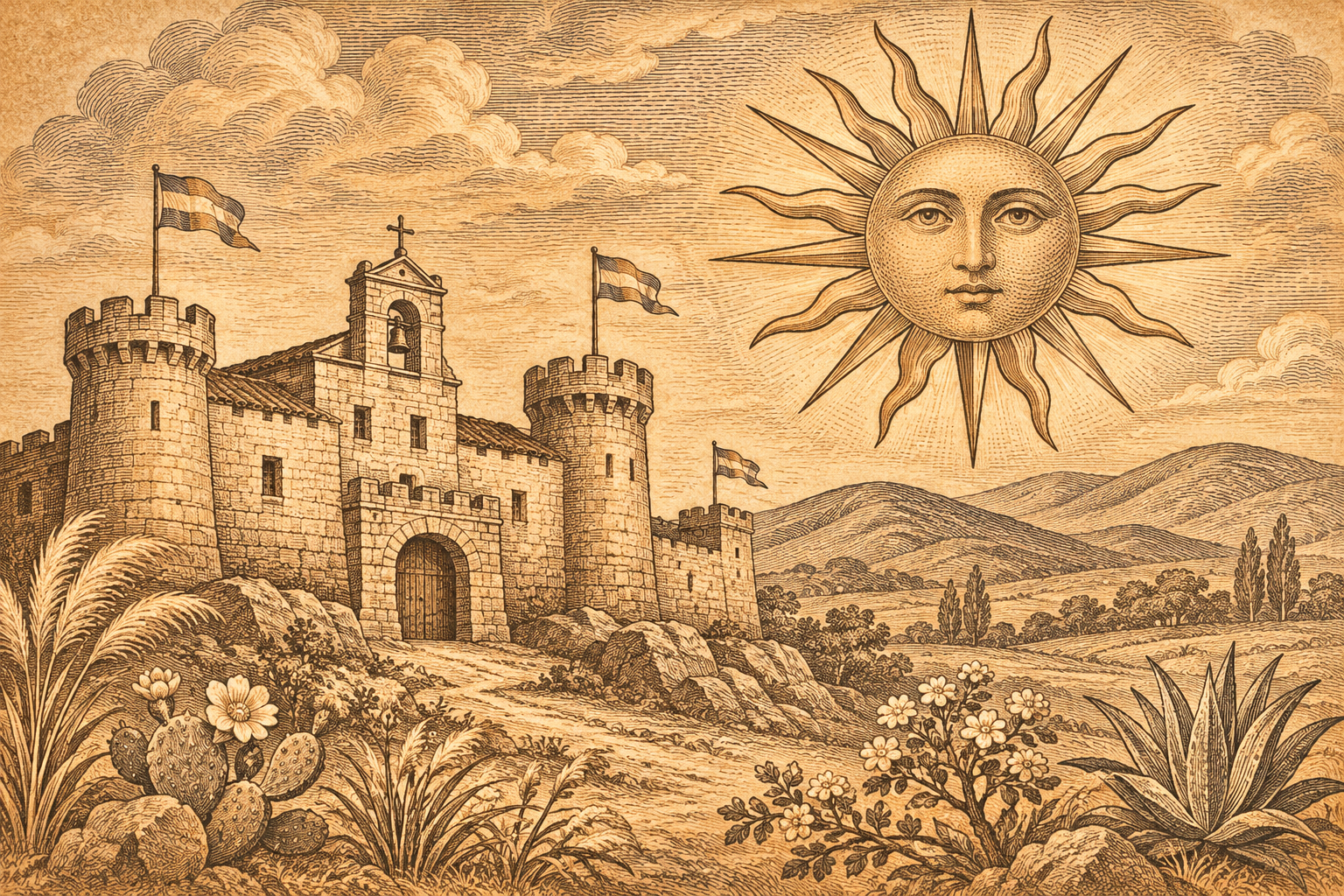
Córdoba took a different path. On February 2, 1844, Governor Manuel López founded the Casa de Moneda de Córdoba. It struck only silver, and its press worked poorly from the very start (Todo Argentina). The design is unlike any other: a castle flying flags, the province's coat of arms, on one side, and a radiant sun with a face and the word CONFEDERADA on the other (coinscatalog.net). The 8 reales of 1852, KM 32, is about 27 grams of silver and 37 mm across (Billetes Argentinos). These coins look nothing like the polished work coming out of Europe, and that's exactly their beauty. They're folk art in silver.
Córdoba is personal for me too. When I traveled there, what stayed with me was its nature and, above all, its people. They're some of the warmest people I've met. Holding one of these coins is like holding a souvenir of that trip.
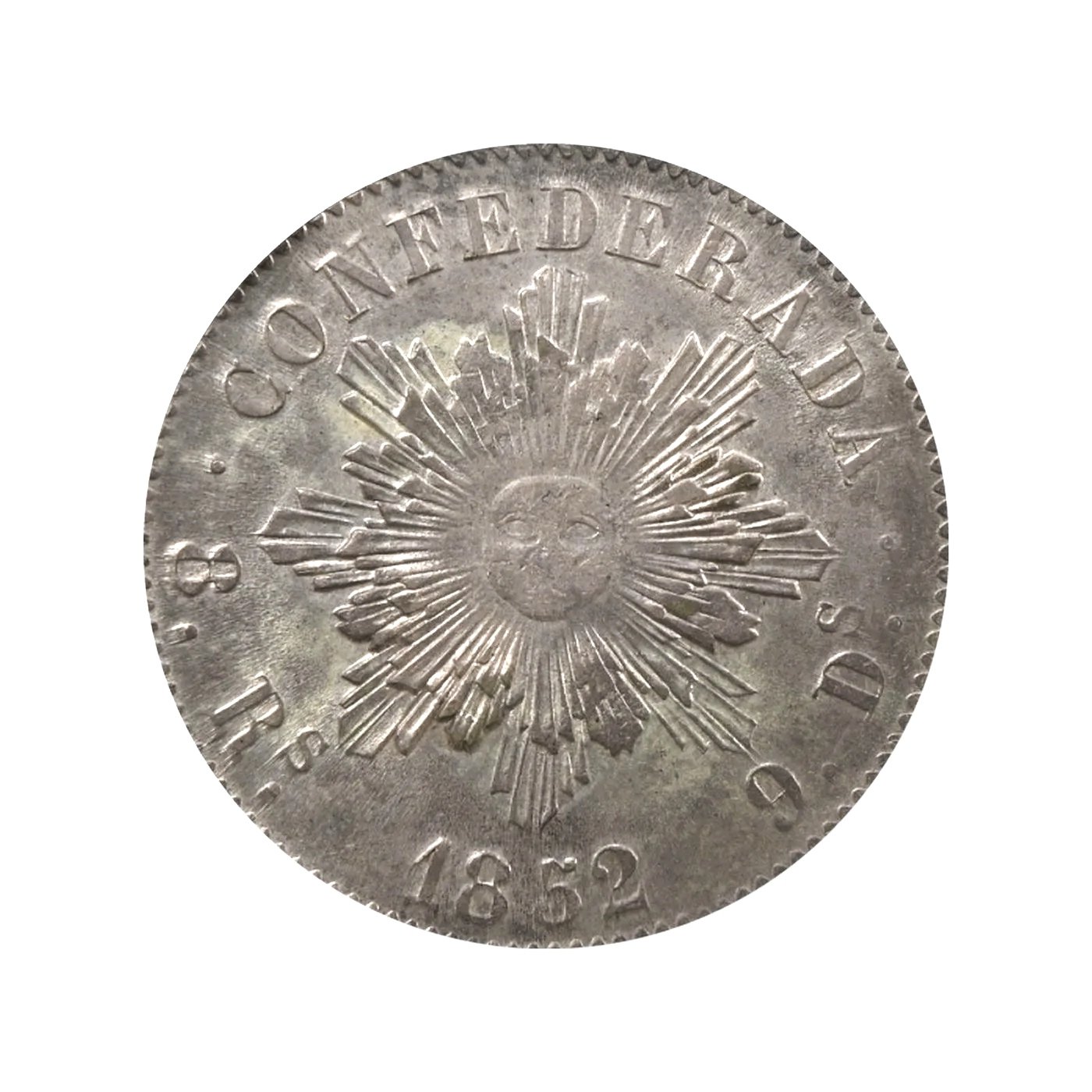
My 1852 Córdoba 8 reales, NGC AU55. The face is softly struck, as is typical of these Córdoba coins, but the rays burst outward in crisp, layered detail.
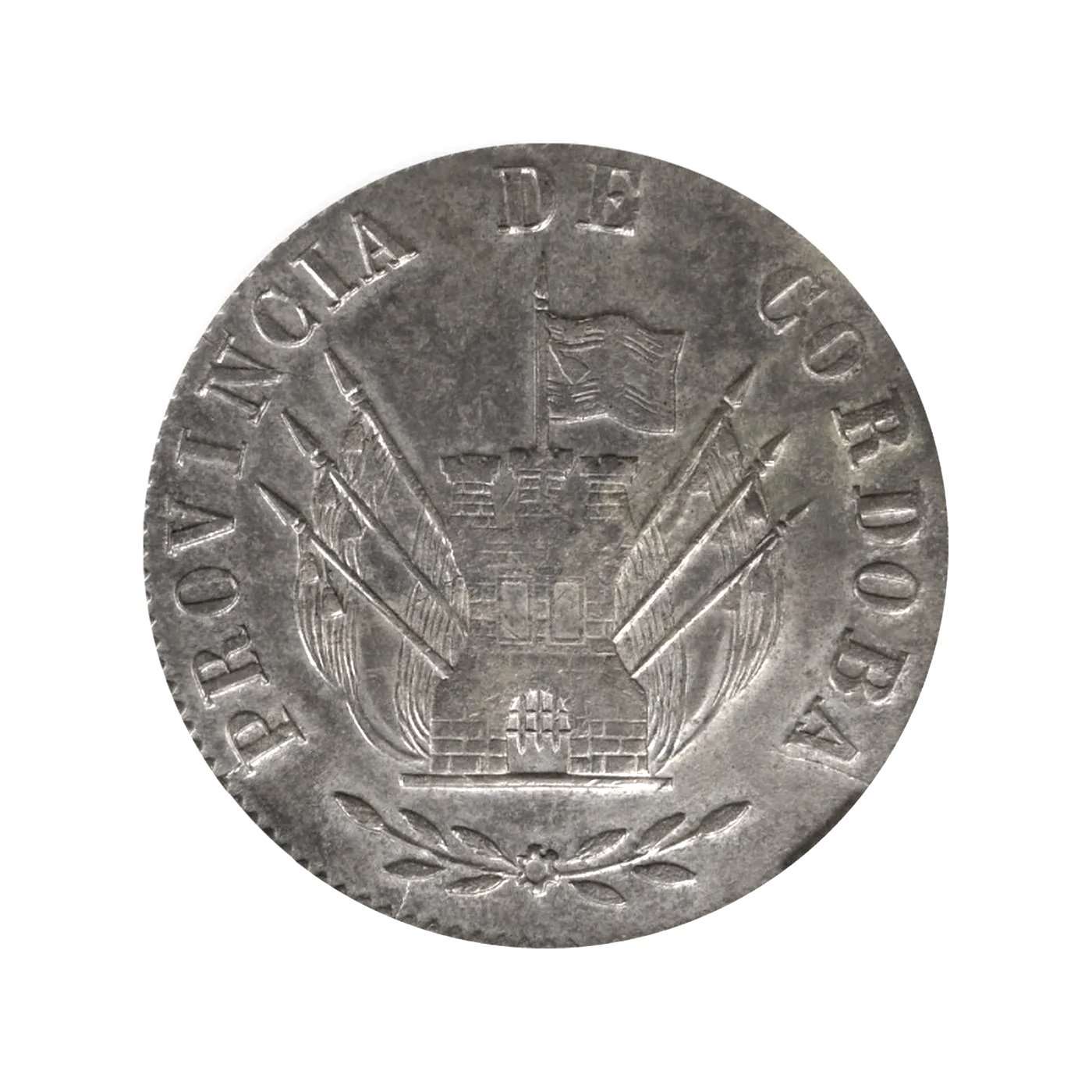
The castle side still shows its original luster under a soft gold and rose toning that only time can create.
The Sun Crosses Borders
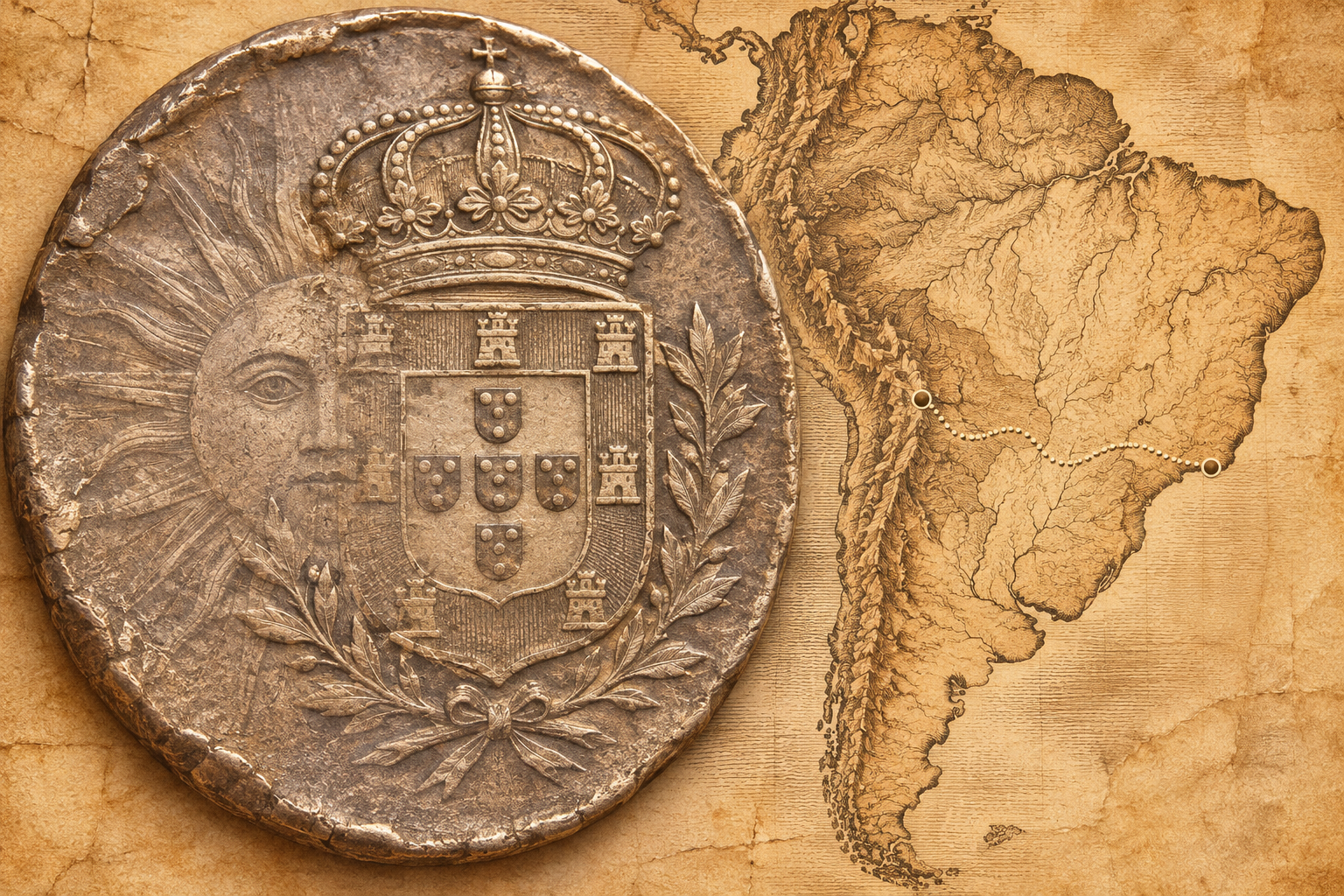
The sun even traveled beyond Argentina. Between 1810 and 1827, Brazil restruck some 22.5 million foreign silver crowns into 960 réis coins, according to Coin Update. Most were Spanish colonial 8 reales, many of them from Potosí. Every so often, though, the host turns out to be the 1813 or 1815 Río de la Plata 8 reales, Argentina's first patriotic coin, struck at Potosí itself. On those rare pieces you can sometimes still see the Sol de Mayo under the Brazilian design.
Heritage Auctions offered one such piece in 2025: an 1819 Rio de Janeiro 960 réis, graded AU55 by PCGS, struck over an Argentine sun-face 8 reales. I've always been fascinated by these pieces: two designs fused into a single coin, and a coin that gets a second life and carries its story forward.
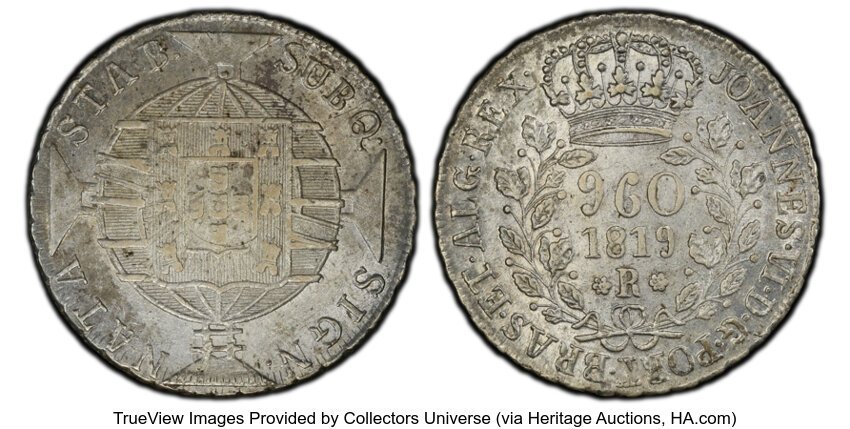
A Brazilian 960 réis of 1819, struck over an Argentine sun-face 8 reales. Photo by Heritage.
Why I Keep Coming Back
Potosí, 1813. Here, silver becomes an image. In the face of the sun I see identity, purpose, and an idea of freedom. The design on the reverse belongs to the same story, but my eye always comes back to that face. Holding the coin today, more than two centuries later, I can still see freedom in that sun.
References and Further Reading
Janson, Héctor Carlos. La moneda circulante en el territorio argentino: 1767–1998. Buenos Aires: H. C. Janson, 1998.
Burzio, Humberto F. Diccionario de la Moneda Hispanoamericana. 3 vols. Santiago de Chile: Fondo Histórico y Bibliográfico José Toribio Medina, 1956–1958.
Cunietti-Ferrando, Arnaldo J. La Casa de Moneda de Potosí durante las Guerras de la Independencia. Buenos Aires: Academia Nacional de la Historia, 2014.
Bentes, Arnaldo. Livro Bentes de Moedas do Brasil.
Bentes, Arnaldo. Livro dos 960 Réis.
Heritage Auctions, Spotlight: Brazil World Coins Showcase Auction 61526, July 13, 2025, lot 21046: Brazil 1819-R 960 réis, PCGS AU55, overstruck on an Argentina sun-face 8 reales.
"The 960 Réis Overstrikes of Brazil." Coin Update.
Cohen, Mariano A. "Monedas de La Rioja 1824–29". Instituto Federal de Investigadores Numismáticos de la República Argentina (IFINRA). English version: "Coinage from the Province of La Rioja, 1824–29", CoinWeek.
